

Most people don’t have a productivity problem. They have a distraction problem, a priority problem, or an energy problem that gets mislabeled as “I just need to work harder.”
If you’ve ever ended a long, exhausting day and struggled to name a single thing you actually finished, you already know this. Busy and productive are not the same thing, and in 2026, that gap has only gotten wider.
This guide walks through 25 productivity tips that hold up under real research, not wishful thinking. Some of them will feel familiar. Others will challenge how you currently think about time, focus, and energy. All of them are things you can start using today.
Why This Matters More Than Ever in 2026
A few years ago, productivity advice mostly focused on to-do lists and willpower. That advice was already incomplete. Now it is almost irrelevant, because the environment we work in has changed faster than our habits have.
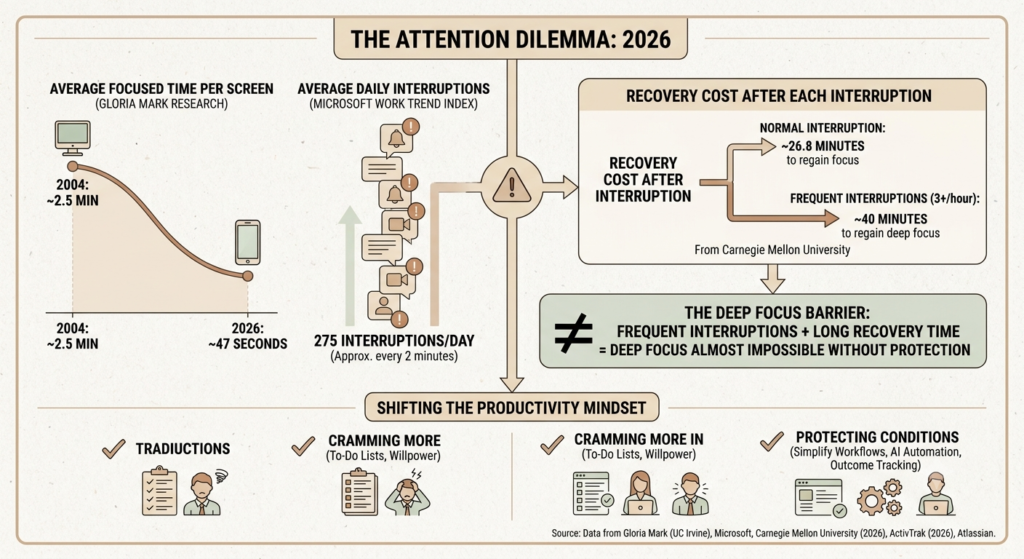
Attention itself has become the scarce resource. Research from Gloria Mark at UC Irvine, whose attention studies span two decades, found that the average time a person holds focus on a single screen has fallen sharply – from roughly two and a half minutes in 2004 to about 47 seconds today. That is not a small decline. That is a fundamental shift in how our brains engage with work.
Interruptions have also become relentless. According to Microsoft’s Work Trend Index, the average employee is now interrupted by a meeting, message, or notification roughly every two minutes during core working hours, adding up to about 275 separate interruptions across a single day. Each of those interruptions carries a cost. A 2026 study out of Carnegie Mellon University’s Human-Computer Interaction Institute, which tracked 3,800 knowledge workers, found that the average time it takes to fully recover focus after a digital interruption is now 26.8 minutes, and workers hit with three or more interruptions per hour needed close to 40 minutes to get back to real depth of concentration.
Put those two numbers together and the picture becomes clear. If you’re being interrupted every two minutes but need close to half an hour to recover from each interruption, true deep focus becomes almost mathematically impossible without deliberate protection.
This is exactly why productivity tips can’t just be about doing more. They have to be about protecting the conditions that let good work happen in the first place. The businesses and individuals who are actually getting ahead in 2026 aren’t the ones cramming more into their day – research on workplace trends shows they’re the ones simplifying workflows, automating repetitive tasks with AI, and shifting from tracking hours logged to tracking outcomes like focus time and measurable results.
That’s the mindset behind everything in this article.
Understanding What’s Actually Killing Your Productivity
Before jumping into fixes, it helps to understand exactly what you’re fighting against. Most people underestimate how much of their day disappears into things that feel like work but aren’t.
The Real Cost of Digital Distractions
The numbers here are sobering. Analysis from ActivTrak’s 2026 State of the Workplace report found that the average focused work session in 2025 lasted just 13 minutes and 7 seconds, a drop of 9% from 2023. Separately, research summarized by Speakwise found that 42% of knowledge workers say they typically cannot spend more than one hour on productive work without being interrupted, and unproductive chat messages alone were found to waste roughly 157 hours per worker every year.
None of this is a personal failure. It’s an environment designed to fragment attention, and most workplace tools make it worse by default, not better.
Why Multitasking Doesn’t Work
Multitasking feels productive because it keeps you moving. But research on context switching tells a different story. Atlassian’s State of Teams research found that the average knowledge worker switches contexts more than 60 times in a single workday, jumping between documents, chat apps, email, and meetings. Every one of those switches carries a hidden tax in lost accuracy, slower thinking, and rising stress.
The takeaway isn’t that you need more discipline. It’s that you need systems that reduce how often your attention gets pulled in a new direction. That’s what the rest of this article is built around.
Time Management Strategies That Actually Work
Time management is the foundation. Get this layer right, and everything else – focus, energy, output – gets easier to control.
1. Time Block Your Calendar
Time blocking means assigning specific tasks to specific hours instead of working from a loose, reactive to-do list. Instead of hoping you’ll “get to” your most important project, you decide in advance exactly when it happens.
A widely cited 2018 study published in the Journal of Consumer Research found that people who used time blocking completed 30% more tasks than those working from unstructured to-do lists. The structure itself does a lot of the heavy lifting – it removes the constant, low-level decision of “what should I do next,” which is a decision that quietly drains mental energy all day long.
Start small. Block two to three hours in the morning, when most people’s cognitive energy is highest, for your single most important task. Push meetings and admin work into the afternoon. Treat that morning block like an appointment you can’t cancel.
2. Use the Pomodoro Technique
The Pomodoro Technique breaks work into short, focused sprints – typically 25 minutes of concentrated effort followed by a 5-minute break, with a longer break after four rounds. It was developed by Francesco Cirillo, and the structure works because it externalizes the decision of when to rest, which removes a common source of procrastination.
Academic research on systematic break-taking backs this up. A study comparing self-regulated breaks against structured, Pomodoro-style breaks found that students using systematic break patterns reported being more concentrated and motivated, and perceived their tasks as less difficult, compared with those who took breaks whenever they felt like it.
If you procrastinate easily or struggle to start tasks, this is one of the simplest productivity tips to implement immediately. All you need is a timer.
3. Try the Eisenhower Matrix for Prioritization
Not everything on your list deserves equal attention. The Eisenhower Matrix sorts tasks into four categories: urgent and important, important but not urgent, urgent but not important, and neither. Most people spend their day reacting to whatever feels urgent, which usually means the “important but not urgent” category – the work that actually moves your goals forward – keeps getting pushed to tomorrow.
Spend ten minutes at the start of each week sorting your task list into these four boxes. You’ll often find that half of what feels urgent doesn’t actually deserve your best hours.
4. Eat the Frog First
This idea, popularized by productivity writers and borrowed from a Mark Twain quote, is simple: do your hardest, most important task first thing in the morning, before anything else competes for your attention. If you tackle your biggest task first, the rest of the day feels lighter by comparison, and you’re not carrying dread around all day.
5. Apply the 80/20 Rule
Also known as the Pareto Principle, this rule states that roughly 80% of your results come from 20% of your efforts. Applied to your workday, this means identifying the small number of tasks that actually drive outcomes and protecting time for those first, rather than treating every item on your list as equally valuable.
Once a month, review your biggest wins from the previous four weeks and trace them back to the actions that produced them. You’ll usually find a short list of high-leverage activities worth repeating – and a long list of busywork worth cutting.
Strategies for Protecting Deep Focus
Time management gets you organized. Focus protection is what actually lets meaningful work happen.
6. Schedule Deep Work Blocks
Deep work is a term coined by Cal Newport to describe distraction-free concentration pushed to your cognitive limit. Newport’s research suggests individuals in a genuine deep-focus state can produce dramatically more output than when they’re distracted – some analyses put the difference as high as 500% more output compared to distracted work.
Despite this, most people barely get any. A 2026 Hubstaff benchmarking report found that the average worker gets only two to three hours of genuine focus time per day, meaning roughly a quarter to a third of the workday is spent in the state that actually produces high-quality output. The rest disappears into meetings, shallow tasks, and recovering from interruptions.
Block at least one 90-minute deep work session daily, ideally at the time of day when your energy is naturally highest. Guard it the same way you’d guard an important client meeting.
7. Batch Similar Tasks
Grouping similar tasks together – answering all your emails in one sitting instead of throughout the day, for example – reduces the number of times your brain has to switch gears. Batching won’t eliminate context switching entirely, but it drastically cuts the frequency, which is where most of the hidden cost comes from.
8. Reduce Meeting Load
Meetings are one of the biggest silent killers of focus time. Microsoft’s own data shows that meetings alone consume 15.4 hours per week for the average knowledge worker, leaving barely 12 hours for actual uninterrupted focus. A study led by researcher Benjamin Laker, reported in Harvard Business Review, found that when organizations cut their meeting load by 40%, employee productivity increased by 71%, along with a meaningful jump in satisfaction.
You may not control your company’s meeting culture, but you can audit your own calendar. Decline recurring meetings that don’t need your input. Suggest async updates instead of status calls. Push for meeting-free mornings if your role allows it.
9. Silence Notifications During Focus Sprints
Notification behavior is almost automatic for most people. Research on smartphone habits found that 76% of people respond to a notification within the first five minutes of receiving it, which effectively turns every single alert into a guaranteed interruption. Turning off non-essential notifications during your deep work blocks isn’t extreme – given how reflexive our response to notifications has become, it may be the only way to protect real focus time.
10. Use the Two-Minute Rule for Small Tasks
If a task takes less than two minutes, do it immediately instead of adding it to your list. This keeps small obligations from piling up into a background hum of mental clutter that quietly drains your attention throughout the day.
Building Better Daily Habits
Systems only work if they’re supported by habits that make them automatic.
11. Design a Morning Routine
How you start your day sets the tone for everything that follows. A consistent morning routine – even a short one – reduces decision fatigue and gives you a sense of control before the day’s demands start pulling at you. This doesn’t need to be elaborate. Waking at a consistent time, avoiding your phone for the first 20 minutes, and reviewing your top priority for the day is enough to make a real difference.
12. Plan Tomorrow Tonight
Spend the last ten minutes of your workday planning tomorrow instead of starting tomorrow morning with a blank page. This single habit removes the most mentally expensive part of any day: figuring out where to start. You’ll walk into the next morning already knowing your first move.
13. Protect Your Energy, Not Just Your Time
Time management alone isn’t enough if you’re scheduling demanding work during your lowest-energy hours. Pay attention to when you naturally feel sharpest – for most people, this is within the first few hours after waking – and protect that window for your hardest work. Save routine, low-effort tasks for your natural energy dips.
14. Take Real Breaks
Breaks aren’t wasted time. Research summarized in WorkTime’s 2026 productivity data found that employees who take regular breaks show 13% higher productivity compared with those who push through without stopping. A real break means stepping away from screens entirely – a short walk, stretching, or simply looking out a window – not switching from work to scrolling social media, which doesn’t give your attention system the rest it actually needs.
15. Track Your Time for a Week
Most people wildly overestimate how much focused work they actually get done. One striking data point: research cited by WorkTime found that office workers average just 2 hours and 53 minutes of genuinely focused work across an entire 8-hour shift. Track your own time honestly for one week using a simple spreadsheet or a time-tracking app. The results are often uncomfortable – and extremely useful.
Working Smarter in the AI-Powered Workplace
The tools available in 2026 are fundamentally different from even a couple of years ago, and ignoring that shift means leaving real leverage on the table.
16. Use AI to Automate Repetitive Work
AI tools have moved from novelty to standard infrastructure in most workplaces. McKinsey’s own analysis estimates that generative AI adoption could unlock up to $4.4 trillion in annual productivity gains worldwide, largely by automating repetitive, low-value tasks that currently eat into people’s days. Identify the parts of your workflow that are repetitive and rules-based – scheduling, first-draft writing, data entry, summarizing – and look for a tool that can take that work off your plate entirely.
17. Consolidate Your Tools
Tool sprawl is a quieter productivity killer than most people realize. Constantly switching between five or six different apps to complete one workflow adds friction and increases the number of context switches you make every day. The trend among high-performing teams in 2026 has shifted toward consolidation – using fewer tools that each do more, rather than a different app for every single task.
18. Set Boundaries Around Availability
Being reachable at all times doesn’t make you more productive; it makes you more interruptible. Set clear expectations with your team or clients about when you’re available and when you’re heads-down. Turn on “do not disturb” during deep work blocks and trust that anything truly urgent will find another way to reach you.
19. Measure Outcomes, Not Hours
The shift toward outcome-based performance is one of the clearer trends shaping 2026 workplaces. Instead of tracking how many hours you logged, track what you actually finished. This reframing does two things: it keeps you honest about whether your time is being spent well, and it removes the false sense of accomplishment that comes from simply staying busy.
20. Build a Weekly Review Habit
Set aside 20 minutes every week to review what worked, what didn’t, and what needs to change. This is one of the most overlooked productivity tips, largely because it doesn’t feel like “real work” in the moment. But without a regular review, small inefficiencies compound silently, week after week, until you’re deep into a system that no longer serves you.
Building Long-Term Sustainability
None of the tactics above matter if they burn you out within three months. Sustainable output requires protecting your capacity, not just your calendar.
21. Prevent Burnout Before It Starts
Burnout prevention has moved from a nice-to-have to a business necessity. Recovery has become just as important a metric as output. Rather than waiting until exhaustion forces a slowdown, build recovery into your schedule the same way you’d build in a client deadline – proactively, not reactively.
22. Protect Recovery Time
One of the more interesting shifts in recent workplace research is the growing focus on recovery hours – uninterrupted evenings and weekends without after-hours messages or notifications – rather than simply tracking working hours. When recovery time collapses, burnout reliably follows. Treat your evenings and weekends as a resource worth defending, not a leftover buffer that gets absorbed whenever work runs long.
23. Say No More Often
Every yes to a low-value request is a quiet no to your highest-priority work. Get comfortable declining meetings, projects, or favors that don’t align with what actually matters to you right now. This is uncomfortable at first, but it compounds – every no you give to something unimportant is time reinvested into something that is.
24. Revisit Your Systems Quarterly
The productivity system that worked for you six months ago might be actively working against you now. Roles change, priorities shift, and tools evolve. Set a recurring reminder every quarter to honestly evaluate whether your current systems still fit your actual workload, rather than running on autopilot with habits you built for a different season of work.
25. Choose Progress Over Perfection
Perfectionism disguises itself as high standards, but it often functions as a stalling tactic. Finishing a solid piece of work today beats endlessly polishing a perfect one that never ships. Give yourself permission to submit the “good enough, on time” version, and reserve perfectionism for the small number of things that genuinely require it.
Applying These Habits in a Team Setting
Individual habits only go so far if the team around you operates on the opposite rhythm. If your calendar is protected but everyone else on your team treats meetings as the default way to communicate, you’ll still end up fighting for focus time every week.
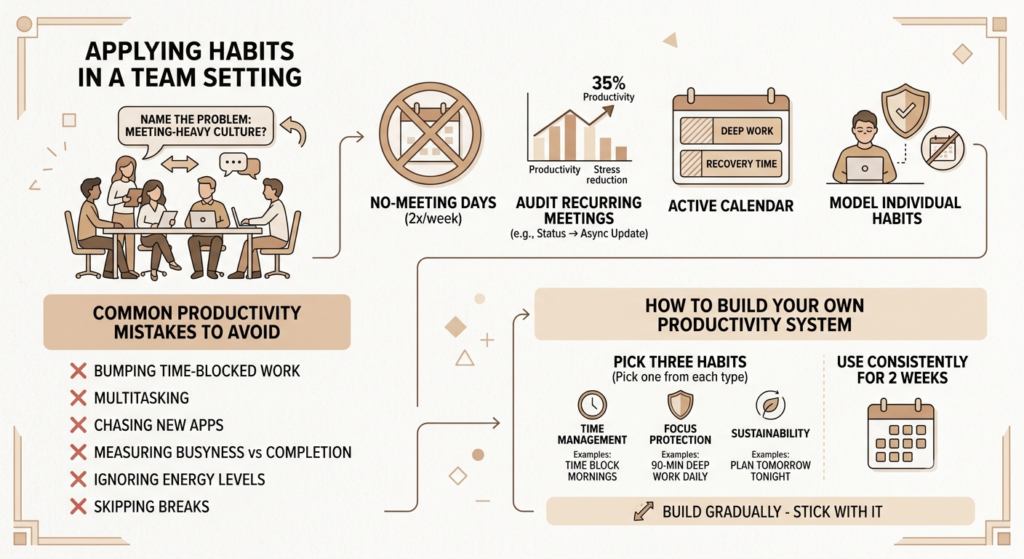
Start by naming the problem out loud with your manager or team. Most people assume meeting-heavy culture is fixed and unchangeable, when in reality it’s usually just unexamined habit. Research on no-meeting days backs this up clearly: a study originally published in MIT Sloan Management Review and replicated in 2026 found that introducing just two no-meeting days per week was linked to a 35% increase in self-reported productivity, alongside measurable drops in stress. That’s not a minor tweak – it’s one of the highest-leverage changes a team can make without touching headcount, budget, or tools.
If you lead a team, consider auditing every recurring meeting on the calendar and asking a simple question: could this be an async update instead? Status meetings, in particular, are often better handled through a shared document or a short written summary. This frees up hours of collective focus time every week without losing any actual communication.
Tool choice matters here too. The current generation of scheduling and calendar tools – built specifically around protecting focus time rather than just displaying it – reflects a broader shift in how teams are starting to think about time. Instead of treating a calendar as a passive record of meetings, forward-thinking teams increasingly use it as an active planning tool that blocks out recovery time and deep work alongside client calls and check-ins.
None of this requires a company-wide policy change to start. You can model these habits at the individual level – turning down unnecessary meetings, defaulting to async updates when possible, and being transparent about when you’re heads-down – and let the results speak for themselves.
Common Productivity Mistakes to Avoid
Even with the right tips in hand, a few habits quietly undo all that progress:
- Treating your calendar as a suggestion instead of a commitment, so time-blocked work constantly gets bumped for whatever feels urgent in the moment.
- Multitasking during meetings or focus blocks, which defeats the purpose of protecting that time in the first place.
- Chasing every new productivity app instead of consistently using one simple system long enough to see results.
- Measuring your day by how busy you felt rather than by what you actually completed.
- Ignoring energy levels and scheduling demanding work during your natural low points.
- Skipping breaks in the name of “pushing through,” which almost always costs more time in reduced focus than it saves.
How to Build Your Own Productivity System
You don’t need all 25 of these productivity tips at once. Trying to implement everything simultaneously is its own kind of productivity trap.
Instead, pick three: one from time management, one from focus protection, and one from the sustainability section. Use them consistently for two weeks before adding anything new. Systems that stick are built gradually, not installed overnight.
A simple starting combination for most people: time block your mornings, protect one 90-minute deep work session daily, and plan tomorrow before you close your laptop tonight. That alone addresses the three biggest productivity killers – reactive scheduling, fragmented focus, and decision fatigue at the start of each day.
Give yourself permission to build this slowly. A system you actually stick with for three months will outperform a perfect-on-paper system you abandon after a week. Write your three chosen habits somewhere visible – a sticky note on your monitor works fine – and track whether you followed through each day for the first two weeks. That simple visibility is often enough to keep new habits from quietly slipping away, which is exactly what happens to most productivity tips that never move past good intentions.
As your system settles in, resist the urge to keep adding more. The goal isn’t to collect every tactic in this article – it’s to find the smallest set of habits that reliably produces your best work, and then protect those habits fiercely. Everything else is optional.
Key Takeaways
- Attention has become the scarcest resource in modern work, with average screen-based focus now down to roughly 47 seconds.
- Interruptions are frequent and costly – recovering full focus after a single interruption can take upward of 23 to 27 minutes.
- Time blocking, the Pomodoro Technique, and the Eisenhower Matrix are proven ways to structure your day around what actually matters.
- Deep work blocks and reduced meeting load consistently produce measurable productivity gains.
- Sustainable productivity depends on protecting recovery time, not just output – burnout prevention and long-term systems matter as much as daily tactics.
- Start small. Three consistent habits will outperform twenty-five habits you abandon within a week.
Frequently Asked Questions
What are the most effective productivity tips for beginners? Start with time blocking and the Pomodoro Technique. Both require minimal setup, and both give you an immediate, tangible sense of structure without needing new tools or software.
How long does it take to build a productivity habit? Most habits take several weeks of consistent repetition before they feel automatic. Give any new system at least two to three weeks before judging whether it’s working for you.
Can AI tools actually improve personal productivity? Yes, particularly for repetitive or administrative tasks like drafting, scheduling, and summarizing. The key is using AI to remove low-value work from your plate, not to replace the deep thinking that drives your best output.
Is multitasking ever a good productivity strategy? Generally, no. Research consistently shows that frequent context switching increases errors and slows down overall output. Batching similar tasks together produces far better results than juggling several at once.
How do I stop feeling busy all day without actually finishing anything? Shift your focus from tracking hours to tracking outcomes. At the end of each day, write down what you actually completed rather than how long you worked. This single change makes it much easier to spot where your time is really going.
What’s the biggest productivity mistake people make? Treating their calendar as flexible for everything except their most important work. Protect your highest-priority tasks with the same seriousness you’d give an unmissable meeting.
Do productivity tips work the same way for remote and in-office workers? Mostly, yes, though the specific obstacles differ. Remote workers tend to struggle more with boundaries between work and personal time, while in-office workers lose more time to spontaneous interruptions and meeting culture. The underlying principles – protecting focus time, batching tasks, and planning ahead – apply to both, even if the tactics you use to defend that time look slightly different depending on your setup.
Conclusion
Productivity in 2026 isn’t about squeezing more hours out of your day. It’s about protecting the conditions – focus, energy, and time – that let good work actually happen. The research is consistent on this point: structure beats willpower, protected focus beats busyness, and sustainable systems beat short-lived bursts of motivation.
You don’t need to overhaul your entire life this week. Pick one tip from this list, use it consistently, and build from there. Real productivity is a system you build one honest habit at a time, not a single hack you install overnight.