
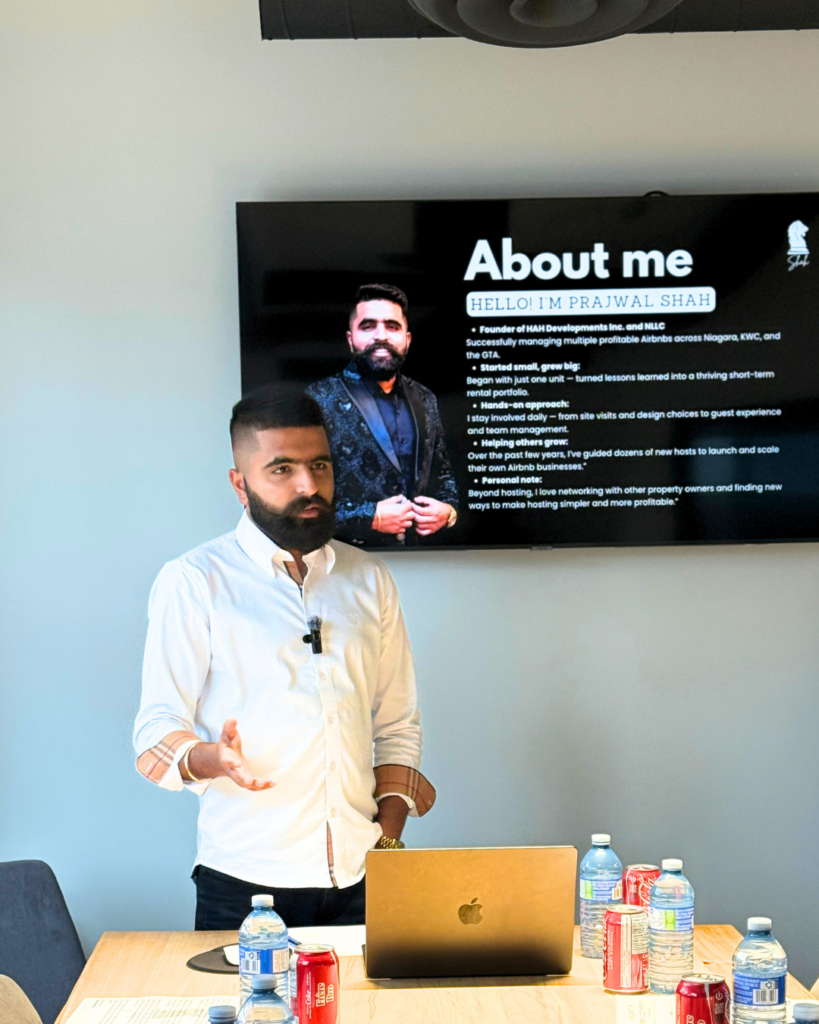
I get asked some version of the same question almost every week: “Prajwal, what should I actually be reading right now?”
It usually comes from someone drowning – a new founder buried under decisions, a small business owner trying to scale past their own bandwidth, an operator staring at a P&L that doesn’t make sense yet. And my answer is always the same. Before you read anything new, read something that’s already been tested by someone who made the mistakes for you.
That’s the entire case for books. A well-written business book compresses ten or twenty years of someone else’s trial and error into a few hours of your attention. You don’t get the scars. You just get the lessons.
This matters more in 2026 than it did five years ago, not less. We are surrounded by AI tools that can summarize anything, generate anything, and answer almost any question in seconds. It’s tempting to think that makes deep reading optional. It doesn’t. AI can give you information. It cannot give you judgment, and judgment is what separates entrepreneurs who last from entrepreneurs who burn out chasing the next tactic. A summary tells you what a book says. Reading the book is what changes how you think.
In this guide, I’ve put together 15 books every entrepreneur should read in 2026 – split by category, matched to different stages of business, and backed by why each one still holds up in an AI-driven economy. This isn’t a list of the same twenty titles every podcast recycles. Think of it as a working entrepreneur reading list 2026, organized so you can actually use it rather than just admire it on a shelf.
I’ve also tried to keep this list honest. Some best business books 2026 roundups just recycle the same fifteen bestsellers every year without asking whether they still apply. A few titles here are genuine classics precisely because the underlying principles haven’t aged. Others earn their place because they speak directly to problems that are new in this decade – AI adoption, remote teams, and a tighter funding environment.
Why Reading Still Gives Entrepreneurs a Competitive Advantage in 2026

Before diving into the list itself, it helps to understand why this particular set qualifies as must-read books for founders in the first place, rather than just a random collection of popular titles.
Learning from successful founders without making expensive mistakes
Every mistake in business costs something – time, money, morale, sometimes the business itself. A book lets you borrow someone else’s mistake instead of making it yourself. When Phil Knight writes about nearly running out of cash at Nike a dozen different times, you get to absorb that lesson at the cost of a paperback instead of at the cost of your own company.
This is the real return on investment of reading. It’s not entertainment. It’s risk reduction.
Developing long-term thinking
Most day-to-day business pressure pulls you toward short-term decisions – this month’s revenue, this week’s fire, today’s inbox. Books force a different pace. They ask you to sit with an idea for three hundred pages instead of three seconds, and that alone retrains your brain to think in longer arcs. Founders who read consistently tend to make decisions with a five-year lens instead of a five-day one, because that’s the lens the best authors are writing from.
Better decision-making under uncertainty
Entrepreneurship is one long series of decisions made without complete information. Books like Thinking, Fast and Slowor The Psychology of Money don’t give you a formula – they give you mental models. And mental models are what let you make a fast, reasonably good decision when you don’t have time for a perfect one.
Building leadership instead of chasing motivation
Motivation fades. Leadership is a skill, and skills are built through repetition and study, not hype. This is one thing the current wave of “hustle culture” content gets backwards – it tries to make you feel something instead of teaching you something. The best leadership books skip the adrenaline and go straight to the mechanics: how to run a hard conversation, how to hold a team accountable, how to make a decision your team will actually follow.
Staying relevant in an AI-driven business world
Here’s the part most reading lists miss. AI has changed what’s valuable to know. Anyone can generate a marketing plan or a first-draft pitch deck in minutes now. What AI cannot generate is your judgment about which plan is right for your specific customer, your specific market, and your specific constraints. That judgment comes from pattern recognition – and pattern recognition comes from exposure to a wide range of business situations, which is exactly what a well-chosen library of books gives you. The entrepreneurs who will separate themselves in the next few years aren’t the ones who can prompt an AI model. They’re the ones who can tell the AI whether its answer is actually good. That’s exactly the gap AI era business books are trying to fill – not by teaching you to use the tools, but by teaching you to judge what the tools produce.
The 15 Best Books Every Entrepreneur Should Read in 2026
This is the core of the list – fifteen books, each with an overview, key lessons, who it’s best for, and why it still matters in a business world reshaped by AI, remote work, and shifting consumer behavior. You’ll notice this isn’t purely a set of startup books for entrepreneurs in the early-stage sense – it deliberately spans the full arc from validating a first idea to running a company that’s meant to last decades.
1. Zero to One – Peter Thiel
Overview: Peter Thiel’s central argument is that true business success doesn’t come from beating your competition – it comes from avoiding competition altogether by building something so new that, for a while, you have no competitors at all.
Key Lessons:
- Going from “zero to one” (creating something new) is more valuable than going from “one to n” (copying something that already works).
- Monopolies, not perfect competition, are what drive outsized profits and innovation.
- Contrarian thinking – asking “what important truth do very few people agree with me on?” – is the starting point of every category-defining company.
Best For: Founders building a genuinely new product or category, rather than a slightly improved version of an existing one.
Why It’s Relevant in 2026: As AI tools make it trivially easy to copy a competitor’s website, offer, or messaging in an afternoon, differentiation has never been harder to fake and never been more valuable to actually have. Thiel’s argument for originality is more urgent now than when the book was published, and it’s one reason this title keeps appearing on nearly every serious list of entrepreneurship books.
2. The Lean Startup – Eric Ries
Overview: Ries introduces the Build-Measure-Learn framework, arguing that startups succeed by treating every product decision as a testable hypothesis rather than a guess dressed up as certainty.
Key Lessons:
- Validate an idea with a Minimum Viable Product before investing heavily in it.
- Treat customer feedback as data, not opinion.
- “Fail fast” isn’t a slogan – it’s a discipline for cutting losses before they compound.
Best For: First-time founders who are still validating whether their idea has real demand behind it.
Why It’s Relevant in 2026: AI has collapsed the cost and time of building an MVP. You can prototype in days what used to take months. That makes the Build-Measure-Learn loop faster than ever – but only if you actually follow the discipline instead of skipping straight to scaling.
3. $100M Offers – Alex Hormozi
Overview: Hormozi breaks down how to construct an offer so compelling that price becomes almost irrelevant to the buyer’s decision.
Key Lessons:
- Pricing strategy should be built around value stacking, not cost-plus math.
- A great offer solves the buyer’s problem so completely that “no” stops feeling like the safe choice.
- Customer value creation, done well, makes selling almost unnecessary.
Best For: Business owners struggling to convert leads or stuck competing on price.
Why It’s Relevant in 2026: In a market flooded with AI-generated marketing copy, a genuinely strong offer is one of the few things that still cuts through the noise, because it’s built on substance rather than wording.
4. The Psychology of Money – Morgan Housel
Overview: Housel argues that financial success has less to do with what you know about money and more to do with how you behave around it.
Key Lessons:
- Wealth is what you don’t spend, not what you earn.
- Behavior and temperament matter more than raw financial intelligence.
- Long-term compounding rewards patience over cleverness.
Best For: Any entrepreneur making pricing, spending, hiring, or reinvestment decisions – which is to say, every entrepreneur.
Why It’s Relevant in 2026: With capital more expensive and funding rounds harder to close than they were a few years ago, a founder’s personal relationship with risk and money directly shapes how the business is run.
5. Atomic Habits – James Clear
Overview: Clear makes the case that lasting change comes from small, consistent systems rather than big, dramatic goals.
Key Lessons:
- Systems produce results; goals only describe them.
- Identity-based habits (“I am someone who ships daily”) outlast willpower-based ones.
- Tiny, 1% improvements compound into significant change over time.
Best For: Entrepreneurs who struggle with consistency more than they struggle with ideas.
Why It’s Relevant in 2026: In a distraction-heavy environment full of notifications and AI shortcuts, the ability to build and protect a consistent system is quietly becoming a competitive advantage in itself. It’s one of the few business mindset books on this list that focuses entirely on the founder’s own behavior rather than strategy or market positioning.
6. Good to Great – Jim Collins
Overview: Collins and his research team studied companies that went from average performance to sustained excellence, and reverse-engineered what separated them from their peers.
Key Lessons:
- “Level 5” leaders combine deep humility with fierce professional will.
- Getting the right people on the team matters more than getting the strategy exactly right first.
- Sustainable greatness comes from disciplined thought and disciplined action, not bursts of inspiration.
Best For: Founders scaling past the startup phase into a company that needs real management structure.
Why It’s Relevant in 2026: As AI automates more operational tasks, the human judgment required to hire, lead, and build culture becomes the scarcer and more decisive skill – exactly what Collins’ research is built around. Among leadership books for entrepreneurs, this remains one of the most rigorously researched, rather than merely anecdotal.
7. The Hard Thing About Hard Things – Ben Horowitz
Overview: Horowitz writes candidly about the parts of running a company that don’t make it into most business books – layoffs, near-bankruptcy, betrayal, and decisions with no good option.
Key Lessons:
- There’s no formula for the hardest calls in business – only judgment, built through experience.
- Managing your own psychology under pressure is a leadership skill, not a personal weakness.
- Clear, honest communication during a crisis builds more trust than optimism does.
Best For: Founders and CEOs navigating a genuine crisis – cash flow problems, leadership shakeups, or existential threats to the business.
Why It’s Relevant in 2026: Economic conditions have forced many founders to make brutal calls around headcount and burn rate. Horowitz’s honesty about that process is more useful now than a decade ago.
8. Never Split the Difference – Chris Voss
Overview: A former FBI hostage negotiator translates high-stakes negotiation tactics into practical tools for business conversations.
Key Lessons:
- Tactical empathy – genuinely understanding the other side’s position – is more persuasive than pressure.
- Calibrated, open-ended questions get better outcomes than direct demands.
- “No” is often the start of a real negotiation, not the end of one.
Best For: Founders negotiating with investors, vendors, or enterprise clients.
Why It’s Relevant in 2026: As more of the transactional parts of sales get automated by AI, the human negotiation skill – reading a room, building trust, closing a nuanced deal – becomes the part that actually needs a person.
9. Blue Ocean Strategy – W. Chan Kim & Renée Mauborgne
Overview: The authors argue that the biggest growth opportunities lie not in beating competitors in an existing “red ocean” market, but in creating uncontested “blue ocean” market space.
Key Lessons:
- Compare your offering across the factors that matter to customers, and look for what the entire industry has ignored.
- Value innovation means pursuing differentiation and low cost simultaneously, not choosing between them.
- Standing out from competitors is a strategic exercise, not a branding exercise.
Best For: Business owners in a crowded, commoditized market looking for a genuine point of differentiation.
Why It’s Relevant in 2026: With AI making it easier than ever to copy a competitor’s product features overnight, competing head-on in a red ocean is riskier than it used to be. Finding uncontested space is a more durable strategy, which is why this title consistently shows up on lists of books on startup growth even though it was written well over a decade ago.
10. Deep Work – Cal Newport
Overview: Newport makes the case that the ability to focus without distraction on cognitively demanding work is becoming rare – and, because it’s rare, valuable.
Key Lessons:
- Shallow, reactive work (email, notifications, meetings) crowds out the deep work that actually moves a business forward.
- Deep work is a trainable skill, not a fixed trait.
- Protecting blocks of undistracted time produces disproportionate output compared to a fragmented schedule.
Best For: Any founder who feels constantly busy but can’t point to what actually got built that week.
Why It’s Relevant in 2026: AI tools have added a new layer of distraction – an infinite well of things to tinker with and optimize. Newport’s argument for guarding deep, uninterrupted focus is arguably more relevant now than when the book was written.
11. The Mom Test – Rob Fitzpatrick
Overview: Fitzpatrick tackles a specific, common failure: entrepreneurs asking customers leading questions and getting false validation in return.
Key Lessons:
- Ask about the customer’s past behavior, not their hypothetical future intentions.
- Avoid pitching your idea during a customer interview – you’re there to listen, not sell.
- Even your mother will lie to you about your business idea if you ask the wrong questions.
Best For: Founders in the earliest stage of validating a product idea.
Why It’s Relevant in 2026: AI has made it cheaper than ever to build the wrong product quickly. Fitzpatrick’s method for getting honest customer signal before you build is a safeguard against wasting that speed on the wrong thing.
12. The E-Myth Revisited – Michael Gerber
Overview: Gerber’s core diagnosis is that most small businesses are built by skilled technicians who understand the technical work of the business but never learn to build the business itself.
Key Lessons:
- Work “on” your business – systems, processes, and structure – not just “in” it, doing the day-to-day tasks.
- Every role in your business should be documented well enough that someone else could step into it.
- A business that depends entirely on the founder isn’t really scalable – it’s just a job with more stress.
Best For: Owners of service-based or operational businesses who feel trapped doing everything themselves. Of all the books for business owners on this list, this is the one most likely to change how you spend your Monday morning.
Why It’s Relevant in 2026: AI-powered tools now make it realistic to systematize and partially automate processes that used to require the founder’s direct involvement – but only if the founder has already documented the business the way Gerber recommends.
13. Shoe Dog – Phil Knight
Overview: Knight’s memoir tells the messy, uncertain, near-failure-filled true story of building Nike, stripped of the polished mythology that usually surrounds a global brand.
Key Lessons:
- Resilience is built through repeated near-disaster, not talent alone.
- Founder mindset means tolerating years of uncertainty before a business becomes obviously “right.”
- Even category-defining companies were, for years, one bad month away from collapse.
Best For: Founders who need a reminder that struggle is normal, not a sign they’re doing something wrong.
Why It’s Relevant in 2026: Founder burnout is widespread, and Knight’s honesty about the exhausting middle years of building something meaningful is a useful, grounding counterweight to the polished “overnight success” narratives common on social media.
14. Start With Why – Simon Sinek
Overview: Sinek argues that the most influential leaders and brands communicate from their purpose outward, rather than starting with what they do.
Key Lessons:
- Customers and employees connect with why a business exists before they connect with what it sells.
- Purpose-driven leadership creates loyalty that outlasts price competition.
- Brand building starts with clarity of purpose, not clever messaging.
Best For: Founders building a brand identity or trying to improve team alignment and retention.
Why It’s Relevant in 2026: As AI makes product features easier to copy, a clear, authentic “why” is one of the few things a competitor genuinely cannot replicate.
15. Built to Last – Jim Collins & Jerry Porras
Overview: This is Collins’ earlier, foundational research (before Good to Great) into what makes a small number of companies endure and outperform for decades, not just years.
Key Lessons:
- Enduring companies are built around a core ideology that doesn’t change, even as strategy and tactics do.
- Visionary companies set “big, hairy, audacious goals” that stretch the organization.
- Long-term business thinking beats short-term optimization almost every time it’s measured.
Best For: Founders thinking beyond the next funding round or fiscal year, toward what they actually want the company to become over a decade or more.
Why It’s Relevant in 2026: With so much current business content optimized for this quarter’s growth hack, Collins and Porras’s research is a useful correction – a reminder that the companies still standing in twenty years were usually built with twenty years in mind from the start.
How to Choose the Right Book Based on Your Business Stage
Not every book on this list belongs on your nightstand right now. The right read depends on where your business actually is.
Starting a Business
- The Lean Startup – validate before you build.
- Zero to One – clarify what makes your idea genuinely new.
- The Mom Test – learn to get honest customer feedback.
Growing Revenue
- $100M Offers – fix your pricing and packaging.
- Never Split the Difference – close bigger, better deals.
- Blue Ocean Strategy – find room to grow without a price war.
Building Leadership
- Good to Great – learn what disciplined leadership actually looks like.
- The Hard Thing About Hard Things – prepare for the calls no one warns you about.
- Start With Why – align your team around a purpose, not just a paycheck.
Personal Growth
- Atomic Habits – build the consistency your business depends on.
- Deep Work – protect the focus your best work requires.
- The Psychology of Money – build a healthier relationship with risk and reward.
This kind of staged approach matters more than reading everything at once. A founder pre-revenue doesn’t need a book on scaling leadership teams yet, and a founder running a fifty-person company doesn’t need another book on validating an MVP. Match the book to the problem you actually have this quarter.
How Successful Entrepreneurs Make Reading a Daily Habit
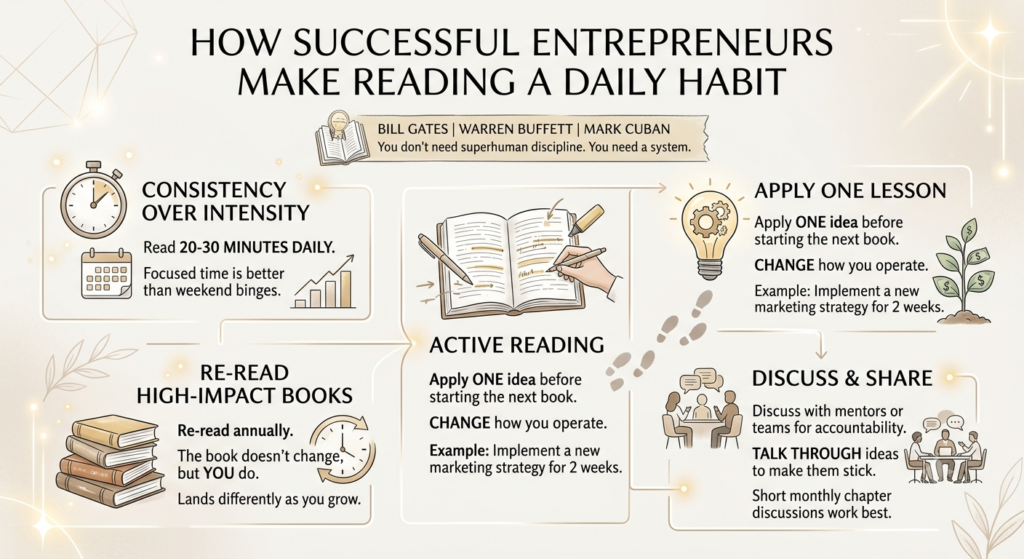
It’s worth being honest about the numbers here, because they’re a little intimidating. Bill Gates reads roughly fifty books a year. Warren Buffett has described spending a large part of most days reading. Mark Cuban has said he reads for several hours daily. Most people hear those numbers and assume they need superhuman discipline to build a reading habit that matters.
You don’t. You need a system, and the system matters more than the intensity.
Reading 20 to 30 minutes every day. Consistency beats volume. Twenty focused minutes a day adds up to more books finished per year than three-hour weekend binges that don’t survive a busy month.
Taking notes and highlighting actionable ideas. A book you read passively is entertainment. A book you read with a pen in hand – flagging what you’re actually going to try – is a working document.
Applying one lesson before starting another book. Finishing a book without changing anything about how you operate is the single biggest waste of the exercise. Pick one idea, implement it for two weeks, then move on.
Re-reading high-impact books annually. The book doesn’t change, but you do. A book you read as a first-time founder lands completely differently once you’re managing a team of fifteen.
Discussing books with mentors or teams for accountability. Ideas that get talked through out loud tend to stick. If you run a small team, consider a short monthly discussion around one chapter or idea, rather than a formal book club that quietly dies after month two.
Common Reading Mistakes Entrepreneurs Should Avoid
Reading only motivational books. Motivation feels good in the moment and fades by Thursday. Mix in books with actual frameworks and mechanics, not just energy.
Never implementing what you learn. This is the single most common failure mode. A shelf of unread wisdom changes nothing about your business.
Skipping timeless classics for trendy releases. New releases chase whatever is trending this quarter. Classics like Good to Great or Built to Last have survived because the underlying principles keep proving true across different markets and decades.
Reading too many books simultaneously. Five half-finished books rarely add up to five books’ worth of applied knowledge. Finish what you start, most of the time.
Collecting books instead of building habits. An impressive bookshelf isn’t the goal. A changed decision-making process is.
Key Takeaways
- The best books every entrepreneur should read in 2026 span strategy, money, leadership, and personal systems – not just motivation.
- Match your reading to your current business stage: starting, growing, leading, or developing personally.
- AI has made information abundant and judgment scarce – deep reading is how you build the judgment AI can’t replace.
- Consistency (20–30 minutes daily) beats occasional binge-reading.
- A book only pays off once you implement at least one idea from it.
Conclusion
Books remain one of the highest-ROI investments an entrepreneur can make – not because reading itself is impressive, but because it’s one of the few habits that consistently compounds. A few hours with the right book can save you months of expensive trial and error.
The best entrepreneurs I know don’t just consume information. They apply it, consistently, one idea at a time, long after the book is back on the shelf.
So here’s the practical move: pick one book from this list – the one that matches the problem you’re actually facing this quarter, not the one that’s trending. Finish it. Apply one lesson before you start the next one. That’s the whole system. It’s not complicated. It’s just rarely done with any discipline, which is exactly why it still works as a competitive advantage.
Frequently Asked Questions
What is the best book for first-time entrepreneurs?
The Lean Startup by Eric Ries and The Mom Test by Rob Fitzpatrick are strong starting points, since both focus on validating an idea before investing heavily in building it.
Which business books are most relevant in 2026?
Books that combine timeless principles with practical relevance to today’s AI-driven, faster-moving market – titles like Zero to One, Deep Work, and The Psychology of Money – tend to hold up best right now.
How many business books should entrepreneurs read each year?
There’s no fixed number. What matters more than the count is consistency and application – reading a handful of books deeply and implementing their lessons beats skimming dozens without acting on any of them.
Are classic business books still worth reading?
Yes. Books like Good to Great and Built to Last remain relevant because they’re built on long-term research into human and organizational behavior, which changes far more slowly than tools or trends do.
Can books help entrepreneurs grow faster than online courses?
They serve different purposes. Courses tend to teach a specific skill quickly; books tend to build deeper judgment and mental models over time. The strongest entrepreneurs generally use both.
Which book is best for improving sales and marketing skills?
Never Split the Difference by Chris Voss for negotiation and sales conversations, and $100M Offers by Alex Hormozi for pricing and offer structure.