
Most people think becoming a CEO is something that happens to you. You work hard, you wait your turn, someone above you retires or gets promoted, and eventually the title lands on your desk. I used to think that way too, early in my career, before I started running my own ventures in property management and Airbnb operations.
Here is what nobody tells you: the title is the last thing that changes. The thinking changes first.
I have sat across the table from people who held senior titles but still thought like employees, and I have worked with junior team members who already thought like owners. The difference was never about rank. It was about how they processed problems, made decisions, and took responsibility for outcomes.
This is not a motivational idea. Research referenced by Harvard Business Review found that more than 60% of CEO performance can be traced back to behavioral traits rather than technical expertise. In other words, the way a leader thinks matters more than their resume. That is genuinely good news, because it means you do not need a corner office to start building that mindset. You can start today, in whatever role you currently hold.
In this guide, I want to walk you through what it really means to think like a CEO, ten specific mindset shifts that separate leaders from employees, the daily habits that reinforce this thinking, and the common traps that keep capable people stuck. By the end, you will have a practical framework you can apply this week, not someday.
What Does It Really Mean to Think Like a CEO?
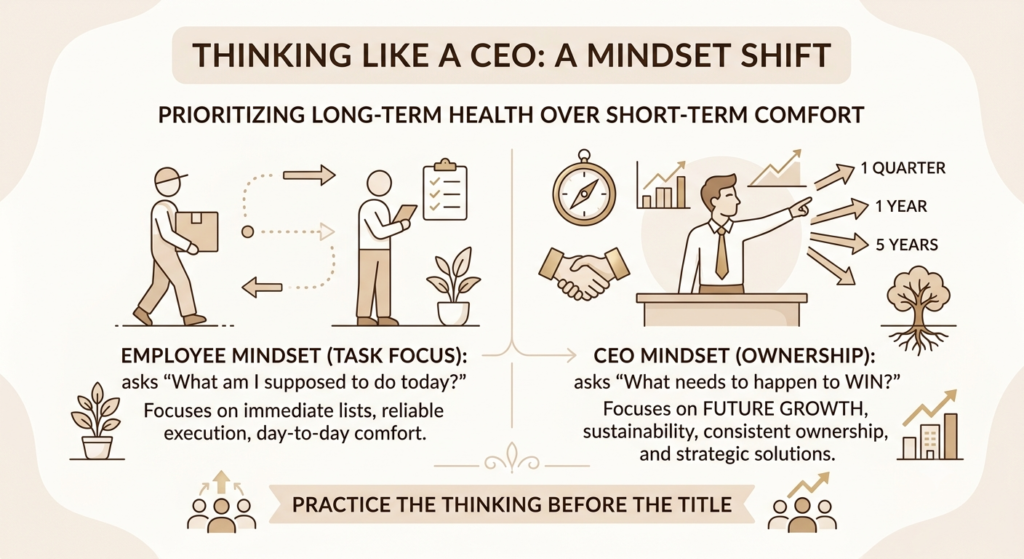
Before we get into the shifts themselves, it helps to define what we are actually talking about. A CEO mindset is not about being bossy, working 80-hour weeks, or wearing a suit on a Tuesday. It is a way of processing information and making choices that consistently prioritizes the long-term health of the business over short-term comfort.
Employee Mindset vs. CEO Mindset
An employee mindset asks, “What am I supposed to do today?” A CEO mindset asks, “What needs to happen for this business to win this quarter, this year, and five years from now?”
This is not a judgment on employees. Most organizations need people who execute tasks reliably. But if you want to grow into leadership, whether you run your own company or you are climbing toward an executive role inside someone else’s, you need to start practicing the second question long before anyone gives you permission to ask it.
A Forbes Business Council piece on this exact distinction makes the point well: leaders with an ownership mindset focus on the future of the business, its growth, and its sustainability, while leaders with an employee mindset tend to attract people who think the same way, creating a culture of limited accountability and short-term thinking.
Mindset Over Title
I have watched people get promoted into leadership roles and completely freeze, because they were waiting for the title to make them think differently. It does not work that way. The thinking has to come first. The title just gives you a bigger stage to apply it.
This is also why mindset influences career growth more than job titles do. People notice when someone consistently brings solutions, takes ownership, and thinks two steps ahead. Promotions tend to follow that pattern of thinking, not the other way around.
With that foundation in place, let’s get into the ten shifts.
Shift #1 – Think in Outcomes, Not Tasks
Most employees are trained to finish their assigned work and move to the next item on the list. That is not a flaw, it is simply how most jobs are structured. But CEOs and senior leaders operate differently. Before doing anything, they ask two questions:
- What result should this create?
- How does this move the business forward?
A task-completion mentality treats work as a checklist. An outcome mentality treats work as a lever. If you are writing a report, the task-focused version of you finishes the report and submits it. The outcome-focused version of you asks what decision this report needs to support, and shapes the document around that decision.
Real-world example: Imagine two property managers handling tenant complaints. One logs the complaint, resolves the immediate issue, and closes the ticket. The other does that too, but also asks: is this a pattern? Is there a maintenance system failing here that will keep generating complaints and costing us money every month? The second person is thinking like a CEO, even if their job title says “coordinator.”
This single shift, training yourself to ask what outcome you are actually responsible for, is often the fastest way to start standing out in any organization.
Shift #2 – Make Decisions Without Waiting for Perfect Certainty
Indecision feels safe, but it is rarely free. Every day a decision sits unmade, the business absorbs a cost, whether that is a missed opportunity, a frustrated team waiting for direction, or a competitor moving first.
CEOs are trained, often through painful experience, to evaluate risk quickly and commit. This does not mean acting recklessly. It means understanding that waiting for 100% certainty is itself a decision, and usually the worst one available.
According to EY’s 2026 CEO Outlook, in a structurally uncertain environment, the leaders who succeed act on imperfect information, experiment and scale quickly, reallocate capital and talent dynamically, and learn through iteration instead of waiting for certainty. That single idea captures the core difference between leaders who move businesses forward and those who stall them.
How Successful Leaders Evaluate Risk
A practical approach looks something like this:
- Gather the information that is realistically available in the time you have, not the information you wish you had.
- Identify the worst realistic outcome, not the worst imaginable one.
- Ask whether that worst outcome is reversible.
- If it is reversible, move. If it is not, slow down and get more input.
Learning Through Action
Most lessons in business are not learned in a classroom, they are learned by making a call, seeing what happens, and adjusting. Overthinking does not eliminate risk, it just delays the learning. The leaders who grow fastest are usually the ones who make more decisions, not the ones who make fewer mistakes.
Shift #3 – Focus on the Long Game
One of the clearest markers of CEO-level thinking is the willingness to sacrifice short-term comfort for long-term growth. This shows up in small, unglamorous ways: reinvesting profit instead of taking it out, building a system instead of just solving today’s fire, or saying no to an easy win that would compromise a bigger goal.
EY’s 2026 research found that CEOs are pursuing growth that is increasingly self-generated, through sharper pricing, portfolio rebalancing, and productivity-funded reinvestment rather than relying on favorable market conditions. That is long-game thinking in action: building internal capability instead of waiting for external tailwinds.
Building Assets Instead of Chasing Quick Wins
An asset is something that keeps producing value after you stop actively working on it: a documented process, a trained team member, a piece of content, a system that runs without you. A quick win is something that produces value once and then disappears.
If you are early in your career, this might look like spending an extra hour documenting how you solved a problem so the next person does not have to start from zero. If you run a business, it might mean investing in a property management system instead of manually tracking every booking by hand. Either way, the long game rewards people who build, not just people who perform
Shift #4 – Take Ownership of Every Outcome
This is, in my experience, the single hardest shift for most people to make, and the most important one.
It is easy to blame the market, a difficult client, an underperforming employee, or bad timing. None of those explanations are necessarily wrong. But they are also not useful, because they put the solution outside of your control.
CEOs train themselves to ask a different question after something goes wrong: “What could I have done differently?” Not because they are always at fault, but because that question is the only one that leads to a better outcome next time.
This matters more than most people realize. Research from the University of Minnesota Duluth, cited by leadership writer Gustavo Razzetti, found that psychological ownership is closely tied to job satisfaction, organizational commitment, and performance, and that accountability and responsibility actually grow out of that sense of ownership rather than the other way around.
In plain terms: ownership comes first. Accountability follows. If you want a team, or yourself, to act accountably, you have to build the sense of ownership first.
Why Accountability Builds Trust
When you take ownership of an outcome, even an outcome that was not entirely your fault, people notice. It builds trust faster than almost anything else, because it signals that you are more interested in solving the problem than protecting your ego.
Shift #5 – Learn to Solve Problems, Not Just Spot Them
Anyone can walk into a meeting and say “this isn’t working.” That observation has very little value on its own. What separates a future CEO is the ability to follow that observation with a path forward.
A simple framework I use, and one I would encourage you to practice, looks like this:
- Problem – State clearly what is actually broken, not just the symptom.
- Cause – Identify why it is happening, not just what is happening.
- Options – Lay out two or three realistic paths forward.
- Best decision – Recommend one, with your reasoning.
If you bring this structure to your manager, your partner, or your team instead of just raising a flag and walking away, you immediately stand out. It shows you are thinking at the level of someone who owns outcomes, not just someone who reports them.
Shift #6 – Think in Systems Instead of Constant Hustle
Hustle culture glorifies exhaustion. CEO-level thinking values something different: building systems that produce consistent results without requiring constant personal effort.
This shift matters more now than ever. In the EY 2026 CEO Outlook, optimizing operations and improving productivity ranked as the leading transformation priority for CEOs across every region surveyed, with Asia-Pacific slightly ahead of the rest. That is not a coincidence. Systems thinking is how serious leaders scale without burning out.
Automation
Automation is not just for large enterprises. If you run a small business or manage a single property, automating recurring tasks, guest messaging, invoice reminders, scheduling, frees up your time for the decisions that actually require your judgment.
Delegation
Delegation is not about offloading work you dislike. It is about identifying which decisions genuinely require your input and which ones can be trusted to someone else, with clear guidelines. Leaders who delegate well are not doing less work, they are doing higher-leverage work.
Standard Operating Procedures (SOPs)
If a process only works when you personally execute it, it is not a system, it is a bottleneck. Writing down how something should be done, even imperfectly at first, turns a one-person dependency into something your team or business can rely on consistently.
Avoiding Burnout Through Repeatable Processes
Burnout often comes from solving the same problem over and over without ever building a permanent fix. Systems thinking interrupts that cycle. Every time you solve a problem, ask yourself: how do I make sure I never have to solve this exact problem again?
Shift #7 – Invest in People Before Profits
Profit is the result of a healthy business, not the input that creates one. People are the input. Great CEOs understand this instinctively, and they treat building strong teams as a direct investment in the company’s future, not a soft skill on the side.
Leadership, at its core, is about multiplying other people’s potential rather than just managing their output. A leader who can only produce results through their own personal effort has a ceiling. A leader who builds a team capable of producing results independently has leverage.
Trust, Communication, and Delegation
This connects directly back to the ownership research mentioned earlier. The Forbes Business Council analysis on this topic notes that when leaders demonstrate genuine commitment to their team’s success, teams respond with higher levels of trust, engagement, and accountability, and that people are more willing to invest discretionary effort when they believe their leader is equally invested in them.
In other words, you cannot demand commitment from a team while treating them as replaceable. Investing in people, through training, clear communication, and real trust, is not generosity. It is strategy.
Shift #8 – Control Your Emotions During Pressure
Business creates pressure. Deadlines slip, clients get upset, numbers come in lower than expected. How a leader responds in those moments shapes the entire culture around them.
This is not a new idea, but it has taken on renewed importance heading into 2026. Industry commentary on executive leadership trends this year points to emotional intelligence as a defining trait, with one franchise founder describing it as a leader’s greatest competitive advantage, since leaders with high emotional intelligence understand team motivations, hidden anxieties, and workplace dynamics, which enables trust-building, conflict resolution, and stronger collaboration. The same analysis points out that managing complexity requires composure under pressure, since executives regularly face high-stakes decisions that affect employees, investors, and customers simultaneously, and that staying steady and clear during uncertainty is itself a leadership skill.
Why Reacting Emotionally Hurts Businesses
A reactive leader makes decisions designed to relieve their own discomfort in the moment, not decisions designed to solve the underlying problem. Teams pick up on this quickly, and it erodes confidence even when the leader’s intentions are good.
The practical takeaway: before responding to a stressful situation, build in a pause, even thirty seconds, to ask whether your response is addressing the actual problem or just your own frustration.
Shift #9 – Never Stop Learning
The moment a leader assumes they have learned enough, they start falling behind. This is especially true now. CEOs heading into 2026 face a business environment shaped by rapid technological change, shifting workforce expectations, and economic uncertainty, all at the same time.
A study from the World Economic Forum and BCG found that nine out of ten CEOs now believe they could speak knowledgeably in an impromptu interview about how a major technology shift like AI directly impacts their industry, a sharp increase from the prior year. That level of fluency does not happen by accident. It comes from leaders deliberately treating themselves as students, not finished products.
How to Build the Habit
- Books – Reading regularly, even in short sessions, compounds knowledge over years.
- Mentors – A good mentor shortens the distance between making a mistake and learning from it.
- Podcasts – Useful for staying current on trends during commutes or downtime.
- Feedback – Actively seeking feedback, rather than waiting for an annual review, accelerates growth dramatically.
Continuous learning is not about collecting credentials. It is about staying useful as the environment around your business keeps changing.
Shift #10 – Ask Better Questions Every Day
The quality of your decisions is often determined by the quality of the questions you ask yourself before making them. This is one of the simplest shifts on this list, and one of the most overlooked.
Some questions worth building into your daily routine:
- What creates the highest value today?
- What can I eliminate?
- What am I avoiding?
- Where should I invest my time?
- What would my future self thank me for?
Notice that none of these questions are about working harder. They are about working on the right things. A Harvard Business School professor studying exceptional leaders for an upcoming book put it simply: the best leaders never stop asking questions, treating their own assumptions, incentives, and blind spots as things to interrogate rather than defend, and treating dissent as data instead of disloyalty. That same instinct, staying curious about your own decisions rather than defensive about them, is something you can practice starting today, regardless of your title.
This is where strategic thinking actually gets built. It is not a personality trait some people are born with. It is a habit of asking sharper questions, consistently, until it becomes automatic.
Daily Habits That Help You Think Like a CEO
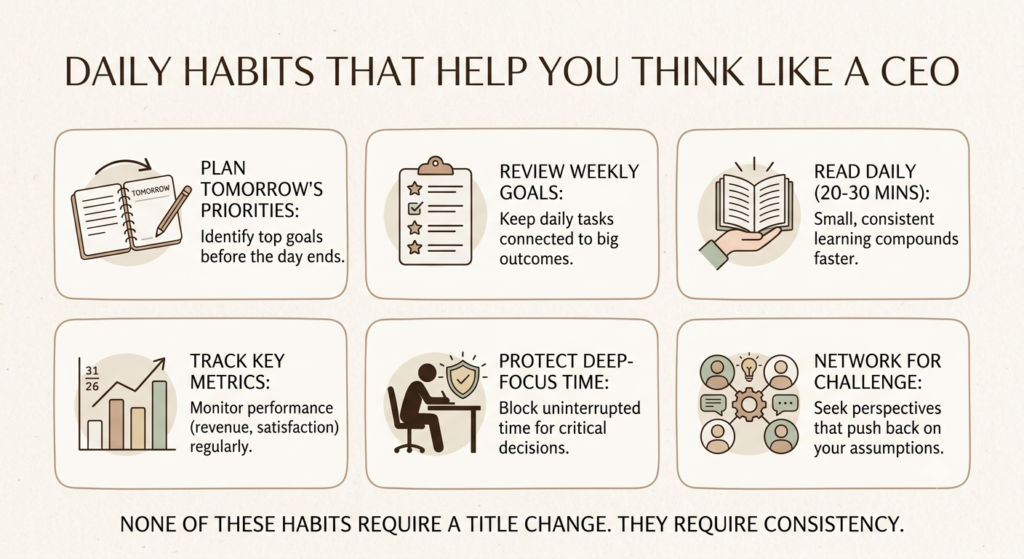
Mindset shifts are abstract until you turn them into daily behavior. Here are habits that reinforce everything covered above:
- Plan tomorrow before ending today. A few minutes spent identifying tomorrow’s top priority prevents the morning from being hijacked by whatever lands in your inbox first.
- Review weekly goals. A short weekly check-in keeps daily tasks connected to bigger outcomes, reinforcing Shift #1.
- Read for 20-30 minutes daily. Small, consistent learning compounds faster than occasional intensive study.
- Track key performance metrics. Whether it is revenue, occupancy rate, or customer satisfaction, leaders who track numbers regularly catch problems early instead of discovering them in a quarterly report.
- Protect deep-focus time. Block uninterrupted time for the decisions that actually require your full attention, rather than letting your calendar fill with reactive meetings.
- Network with people who challenge your thinking. Surrounding yourself only with people who agree with you is comfortable, but it slows growth. Seek out perspectives that push back on your assumptions.
None of these habits require a title change. They require consistency.
Common Mistakes That Keep People Stuck in an Employee Mindset
Even motivated professionals fall into patterns that quietly reinforce employee-level thinking. Watch for these:
- Waiting for permission. Asking “can I do this?” when the real question should be “what is the best move here, and how do I make the case for it?”
- Chasing busyness over impact. Staying constantly occupied feels productive, but it is not the same as creating outcomes that matter.
- Fear of making decisions. Avoiding choices to dodge the risk of being wrong, which usually creates a worse outcome than a wrong decision made quickly and corrected.
- Avoiding difficult conversations. Letting small issues fester because addressing them feels uncomfortable, which almost always makes the eventual conversation harder.
- Micromanaging instead of empowering others. Holding onto control so tightly that no one else is able to grow into responsibility, which caps the entire team’s potential.
Interestingly, research on workplace accountability suggests this last point is widespread. One major accountability study found that organizations are facing what researchers call an accountability crisis: leaders understand that accountability is vital for success, yet 82% of respondents say they have limited to no ability to actually hold others accountable, even when they try. This reinforces a point made earlier in this guide: accountability does not start with control, it starts with building genuine ownership first.
Final Thoughts
Becoming a CEO, in title or in practice, starts with how you think, not with a promotion, a business card, or a corner office. Every shift covered in this guide, thinking in outcomes, owning results, focusing on the long game, controlling your reactions under pressure, can be practiced starting today, regardless of where you currently sit in an organization.
You do not need to adopt all ten shifts at once. Pick one. Practice it deliberately for a few weeks until it becomes instinctive, then move to the next. Leadership is not built in a single dramatic moment. It is built through consistent habits and strategic thinking that compound quietly, day after day, until one day you realize you are already leading, whether or not anyone has given you the title yet.
Frequently Asked Questions
1. Can I start thinking like a CEO even if I am not in a leadership role yet?
Yes. In fact, this is the entire premise of building a CEO mindset early. Mindset shifts like taking ownership of outcomes, asking better questions, and solving problems instead of just spotting them can be practiced in any role, regardless of title.
2. How long does it take to build a CEO mindset?
There is no fixed timeline, since this is a set of habits rather than a single skill. Most people notice a shift in how others perceive them within a few months of consistently practicing ownership, outcome-focused thinking, and better decision-making.
3. Is a CEO mindset only useful for people who want to start a business?
No. These mindset shifts apply equally to corporate professionals aiming for promotions, property managers running operations, and entrepreneurs building their own ventures. The thinking translates across contexts.
4. What is the biggest difference between an employee mindset and a CEO mindset?
The clearest difference is ownership. Employee mindset tends to focus on completing assigned tasks, while CEO mindset focuses on outcomes and takes responsibility for results, even when things go wrong.
5. Do I need to take more risks to think like a CEO?
Not recklessly. CEO-level risk-taking is calculated and structured, weighing realistic downside against potential impact, rather than gambling impulsively.
6. How do daily habits connect to long-term leadership growth?
Small, consistent habits, like planning ahead, reading regularly, and tracking key metrics, build the discipline that larger strategic decisions depend on. Leadership growth compounds through repetition, not occasional bursts of effort.