

Two founders start businesses in the same industry, at the same time, with similar capital and comparable skills. Three years later, one is still operating, slowly building momentum. The other shut down within the first eighteen months.
It’s tempting to explain the gap with talent, luck, or market timing. Sometimes those factors matter. But in a lot of cases, the real difference shows up earlier and more quietly-in how each person responded the first time something didn’t work.
This is the territory that psychologist Carol Dweck mapped out in her research on mindset. Her core idea, popularized in the 2006 book Mindset: The New Psychology of Success, was simple: people tend to operate from one of two belief systems about ability. A fixed mindset treats skills and intelligence as static traits you either have or don’t. A growth mindset treats them as capacities that develop through effort, feedback, and time.
The concept caught on fast-in classrooms, in corporate training programs, and eventually in business and entrepreneurship content everywhere. It’s also, fairly enough, been simplified into something close to a motivational slogan: think positive, work hard, anything is possible.
That version isn’t quite accurate, and it isn’t particularly useful either.
What’s less commonly discussed is that the original research has been scrutinized over the past several years. Some large-scale attempts to replicate Dweck’s most-cited findings came back with mixed or weaker results than expected. Dweck herself has acknowledged that the concept is “more complex than we imagined” and that implementation, especially outside controlled studies, often gets misunderstood.
None of that means the underlying idea is wrong. It means the picture is more conditional than the popular version suggests-and for entrepreneurs and business owners, the more accurate picture is actually more useful than the simplified one. This article walks through both mindsets, what the evidence does and doesn’t support, and how the distinction plays out in real business decisions-without the inflated claims.
What Is a Mindset, and Why the Growth Mindset vs Fixed Mindset Question Matters
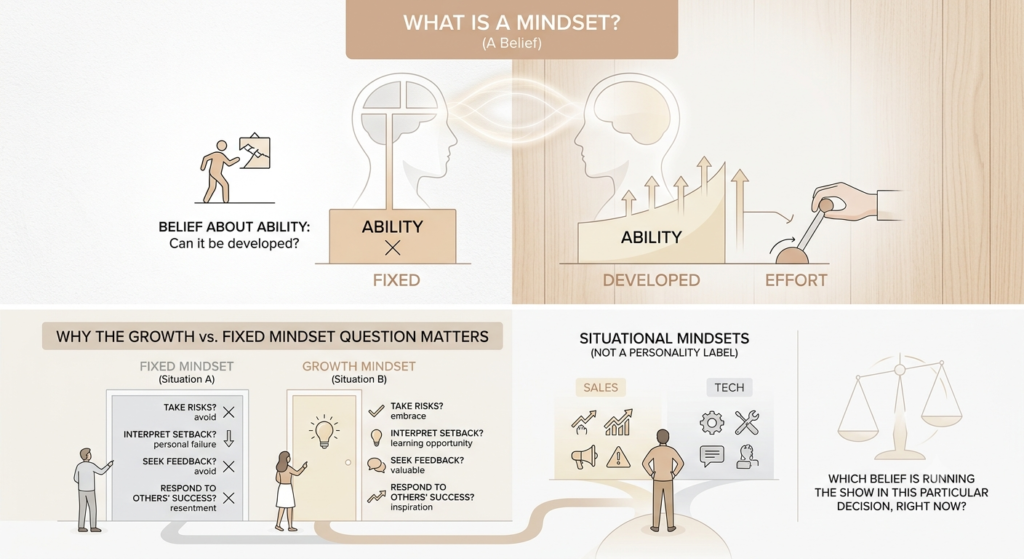
A mindset, in Dweck’s framework, is a belief about whether ability is fixed or can be developed. It’s not a personality type, and it’s not the same as being an optimist or a pessimist. It’s narrower and more specific than that: it’s what you believe happens when you put effort into something you’re not naturally good at.
That belief quietly shapes a lot of downstream behavior. It influences whether you take on a task you might fail at, how you interpret a setback, whether you ask for feedback or avoid it, and how you respond when someone else succeeds where you didn’t.
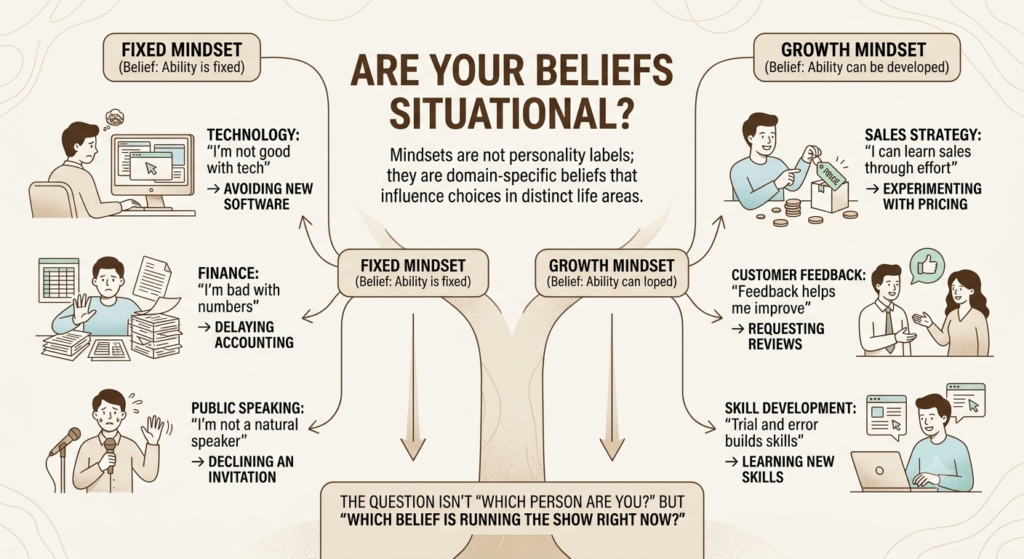
Here’s the part that often gets left out of summaries: almost nobody operates from one mindset all the time. A business owner might have a strong growth mindset about sales and pricing strategy, built from years of trial and error, but a rigid fixed mindset about technology or finance-areas where early struggles left a lasting impression. Mindset tends to be domain-specific and situational, not a fixed personality label you carry into every room.
That nuance matters because the Growth Mindset vs Fixed Mindset question isn’t really “which type of person are you.” It’s “which belief is running the show in this particular decision, right now.”
What Is a Fixed Mindset?
Core Belief
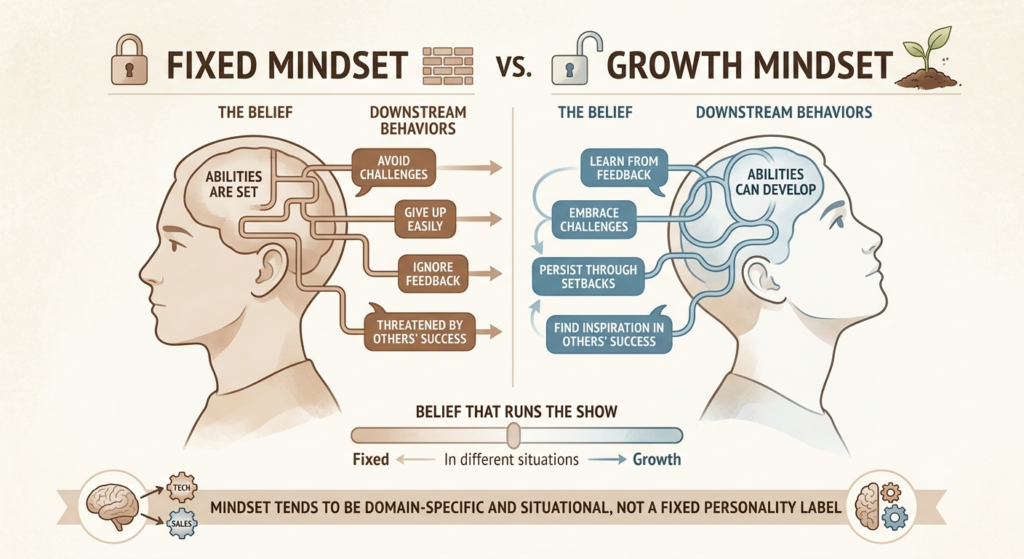
A fixed mindset operates on the assumption that talent, intelligence, and ability are largely set. You’re either good at something or you’re not, and effort doesn’t meaningfully change that. From this view, struggling with a task isn’t a normal part of learning-it’s evidence that you’re in the wrong arena.
How It Shows Up in Business
This belief shows up in patterns that are easy to recognize once you know what to look for:
- Avoiding tasks where failure would be visible. A business owner with a fixed mindset might delay launching a new service or product because an underwhelming response would feel like proof they don’t have what it takes.
- Defensiveness around feedback. Critical feedback gets received as a verdict on identity rather than information about a process. It’s hard to separate “this approach isn’t working” from “I am not capable.”
- Treating setbacks as identity statements. Phrases like “I’m just not a numbers person” or “I’ve never been good at sales” turn a skill gap into a permanent trait.
- Giving up shortly after a setback. Because the underlying belief is that ability is fixed, persistence can feel pointless. If effort won’t change the outcome, why keep trying?
- Comparing outcomes to competitors instead of studying them. A competitor’s success gets read as a threat or a stroke of luck, rather than a source of information about what’s working in the market.
None of this means someone with fixed-mindset tendencies is incapable of running a business. Plenty of people build successful companies while carrying fixed beliefs in certain areas. But these patterns tend to create blind spots-particularly around feedback and adaptation, both of which matter more as a business scales.
What Is a Growth Mindset?
Core Belief
A growth mindset operates on the belief that abilities develop through effort, the right strategy, and consistent feedback. Struggling with something isn’t proof you’re unsuited to it-it’s part of how the skill gets built. This doesn’t mean everyone can become equally skilled at everything with enough effort. It means current ability isn’t treated as a permanent ceiling.
How It Shows Up in Business
- Treating mistakes as data, not verdicts. A failed marketing campaign gets reviewed for what it reveals about the audience or the offer, rather than filed away as proof the business “isn’t working.”
- Actively requesting feedback rather than avoiding it. This often looks less dramatic than it sounds-it might just be a habit of checking in with customers or staff after something goes wrong, rather than only after something goes right.
- Iterating on strategy after failure instead of quitting. The response to a setback is usually “what would I change,” not “should I stop.”
- Comparing notes with competitors instead of comparing status. A growth-oriented business owner is more likely to study what a successful competitor is doing differently and ask what’s transferable.
An Important Caveat
This is the part that a lot of business content skips: growth mindset is not the same as “just work harder.” Effort without the right strategy doesn’t reliably produce better results. Later research on mindset theory, including work from Dweck’s own collaborators, has emphasized that growth mindset is most useful when it’s paired with good feedback and a sound strategy-not as a substitute for either one.
In other words, believing you can improve is the starting point. What actually produces improvement is the combination of that belief with accurate feedback, a workable plan, and enough repetition to refine it. A founder who works eighty-hour weeks without ever changing their approach isn’t demonstrating a growth mindset. They’re demonstrating effort without adjustment, which tends to produce burnout rather than progress.
Growth Mindset vs Fixed Mindset: A Side-by-Side Comparison
| Situation | Fixed Mindset | Growth Mindset |
| Challenges | Avoids them | Engages with them |
| Failure | Treats it as a stopping point | Treats it as information to act on |
| Feedback | Takes it personally | Uses it to adjust the approach |
| Success of others | Feels threatened by it | Studies it for useful insight |
| Learning | Stops after the basics are mastered | Continues building skills over time |
| Effort | Sees it as a sign of weakness | Sees it as part of building mastery |
This table is a simplification, and it’s worth treating it that way. Most people will recognize themselves on both sides depending on the situation. The value of the comparison isn’t to sort yourself into a category-it’s to make the contrast concrete enough to notice in your own decisions.
What the Research Actually Shows (and Where It’s Been Overstated)
It’s worth being direct about this, because most articles on this topic aren’t.
Dweck’s original research, and a substantial body of follow-up work, found real associations between growth mindset beliefs and outcomes like resilience after failure and persistence in learning. That part of the research base is genuine and has held up reasonably well in many contexts, particularly in education.
At the same time, some of the most prominent claims attached to growth mindset theory have been challenged. A widely cited 2018 large-scale study testing school-based growth mindset interventions found the effects were smaller and less consistent than earlier research suggested. Attempts to replicate some of Dweck’s most-cited original studies have reported limited support for the idea that growth mindset reliably improves children’s response to failure or academic performance on its own. Some researchers have also raised pointed questions about how mindset theory has been marketed, separate from what the data supports.
Dweck and her colleague David Yeager addressed this directly in a 2020 paper, noting that growth mindset effects depend heavily on context, implementation, and the specific conditions under which they’re measured. That’s a more careful, conditional statement than the version that usually circulates in business and self-help content.
What does this mean practically? It means growth mindset is a real, useful concept-but it isn’t a guaranteed formula, and it isn’t a substitute for strategy, market conditions, financial discipline, or sound decision-making. Treating it as the single variable that determines business success oversells what the research actually supports. Treating it as one factor among several, one that shapes how you respond to setbacks and feedback, is a more accurate and more durable way to apply it.
For a business owner, the honest takeaway is this: your mindset will not save a fundamentally flawed business model, and it won’t replace the need for good systems. But it will shape whether you notice the flaw early enough to fix it, and whether you’re able to act on that information when you do.
Signs a Fixed Mindset Might Be Holding Your Business Back
Some patterns are easier to spot in hindsight than in the moment. A few common ones worth checking against your own decisions:
- You avoid decisions where you might be visibly wrong. Delaying a launch, a price change, or a hard conversation because being wrong publicly feels worse than staying stuck.
- You react defensively to customer or team feedback. Negative feedback gets met with explanation or dismissal before it gets considered.
- You keep using a process that isn’t working because changing it feels like admitting failure. The sunk-cost version of this is common: “We’ve already invested so much in this approach.”
- You compare your business to competitors instead of studying what they’re doing differently. Their growth becomes a source of frustration rather than information.
- You treat slow growth as proof you’re not cut out for this. A plateau gets read as a personal verdict rather than a normal phase that most businesses go through.
- You constantly seek validation rather than useful input. There’s a difference between asking “did I do a good job” and asking “what would make this better.”
None of these signs mean a business is doomed. They’re worth noticing because they tend to slow down the feedback loop between a problem and a fix-and in business, that lag is usually what turns a fixable issue into a serious one.
Why Entrepreneurs Benefit From a Growth-Oriented Approach
Resilience During Downturns
Every business hits a period where revenue dips, a key client leaves, or a plan simply doesn’t pan out. A growth-oriented response treats that period as something to analyze and adjust to. A fixed response is more likely to read it as confirmation that the business-or the owner-wasn’t capable to begin with. The first response keeps you moving. The second tends to stall decision-making at exactly the moment it matters most.
Better Decision-Making Under Uncertainty
Running a business involves constant decisions made with incomplete information. A growth mindset makes it easier to treat a decision as provisional-something you can revisit and adjust as new information comes in-rather than something that has to be right the first time. That flexibility matters more than getting every initial call correct.
Building Teams That Can Adapt
How a leader responds to mistakes sets the tone for an entire team. If errors are met with blame, people stop flagging problems early and start hiding them instead. If errors are treated as something to learn from, problems tend to surface sooner-while they’re still cheap to fix. This is one of the more practical, less talked-about reasons mindset matters in a leadership context: it directly affects how much accurate information reaches you.
Adapting to Market Changes
Markets shift. Customer expectations change. A pricing model that worked two years ago might not work today. A growth-oriented owner treats this as a normal part of running a business and adjusts the approach. A fixed-mindset response is more likely to hold onto a method that used to work, even after it’s stopped working, because changing course can feel like an admission that the original approach was flawed.
A Real Business Example
Consider a small property management company managing a handful of rental units. In its first year, the business loses two long-term tenants in a row, both citing slow response times to maintenance requests. A fixed-mindset response might be to assume the business simply isn’t a good fit for property management, or to blame the tenants as difficult to please.
A growth-oriented response looks different: review the maintenance request process, ask the departing tenants directly what could have been better, and identify a specific operational gap-maybe requests were getting lost between phone calls and follow-up, or there was no clear system for prioritizing urgent issues. The fix isn’t dramatic. It’s usually a process change: a shared tracking system, clearer response-time commitments, a single point of contact for maintenance issues.
This is a small, unglamorous example, and that’s the point. Most of the mindset distinction in business doesn’t show up in big dramatic moments. It shows up in whether a recurring problem gets investigated or absorbed as “that’s just how it is.”
7 Practical Ways to Build a Growth Mindset in Business
1. Replace “this isn’t working” with “this isn’t working yet-what’s the next test?” This small language shift keeps a setback framed as a stage in a process rather than an endpoint. It’s not about forced positivity. It’s about leaving the door open for the next adjustment instead of closing it.
2. Build a habit of asking for direct feedback, not just metrics. Numbers tell you what happened. Conversations with clients, customers, or staff tell you why. Make it a regular practice-monthly check-ins, short post-project debriefs, or simple follow-up questions after a sale is lost.
3. Track progress in small increments, not just final outcomes. A business that only measures success at the finish line misses the information available along the way. Break larger goals into checkpoints so you can adjust course before a small problem becomes a large one.
4. Treat every failed initiative as a debrief, not a verdict. When something doesn’t work, separate the analysis from the emotion. What was the assumption going in? What turned out to be wrong about it? What would you test differently next time? Write it down. The discipline of doing this consistently matters more than doing it perfectly.
5. Read outside your industry to challenge assumptions. Operators get stuck on the same set of conclusions partly because they’re only exposed to the same set of inputs. Reading about how other industries solve similar operational or customer-experience problems can surface approaches you wouldn’t otherwise consider.
6. Build a team or peer group that treats mistakes as informative, not shameful. This is as much a leadership decision as a personal one. If your team is afraid to admit something went wrong, you’ll find out about problems later than you should, when they’re harder and more expensive to fix.
7. Pair effort with strategy reviews-effort alone isn’t the goal. Periodically step back and ask whether the current approach is actually working, not just whether you’re putting in the hours. Effort that isn’t reviewed and adjusted tends to produce diminishing returns. This is the corrective to the “just work harder” misreading of growth mindset theory.
Common Myths About Growth Mindset
Myth: Growth mindset means staying positive no matter what. It doesn’t. Growth mindset is about how you respond to a setback, not about denying that the setback happened or pretending it doesn’t matter. Acknowledging a real problem is part of addressing it.
Myth: More effort always equals better outcomes. Effort matters, but only when it’s paired with a strategy that’s actually working or being adjusted. Working harder at an approach that’s fundamentally flawed tends to produce burnout, not progress.
Myth: You either have a growth mindset or you don’t. Mindset is domain-specific and situational. Most people show growth-oriented thinking in some areas of their life or business and fixed-mindset thinking in others. The goal isn’t a permanent label-it’s noticing which one is active in a given decision.
Myth: Developing a growth mindset is a one-time decision. It’s an ongoing practice, not a switch you flip once. Old patterns resurface, especially under stress or after a string of setbacks. Building the habit takes consistent, repeated attention rather than a single moment of realization.
Final Thoughts
Mindset isn’t a magic variable that determines whether a business succeeds. The research is clearer about that today than it was when the concept first became popular. But mindset does shape something real and practical: how quickly you notice a problem, how willing you are to hear hard feedback, and whether a setback becomes information or an ending.
Every experienced entrepreneur has had fixed-mindset moments-defensiveness around a bad review, reluctance to change a process that isn’t working, the urge to avoid a conversation that might confirm something uncomfortable. The difference isn’t whether those moments happen. It’s whether they get noticed and corrected, or left to quietly shape decisions in the background.
The next time a decision in your business doesn’t go the way you expected, it’s worth pausing on one question: are you treating this as proof of what you can’t do, or as information about what to try next?
Frequently Asked Questions
Is growth mindset proven by science?
Parts of it are well-supported, particularly the link between growth-oriented beliefs and resilience after setbacks. Other claims, especially around how strongly mindset alone predicts academic or business outcomes, have been challenged by later replication studies. The most accurate current view is that growth mindset is a real and useful factor, but a conditional one-not a guaranteed formula for success.
Can a fixed mindset be changed permanently?
Mindset tends to shift gradually with consistent practice rather than through a single decision. It’s also domain-specific, so someone can develop a growth mindset in one area of their business while still carrying fixed-mindset patterns in another. Ongoing awareness matters more than a one-time change.
Does growth mindset apply to business the same way it applies to school?
The underlying principle-treating setbacks as information rather than verdicts-applies in both settings. But business outcomes depend on many additional factors, including market conditions, financial management, and execution, so mindset alone won’t determine results the way it might in a narrower academic context.
What’s the difference between growth mindset and just being optimistic?
Optimism is a general outlook about how things will turn out. Growth mindset is more specific: it’s a belief about whether ability and skill can improve with effort. You can be realistic, even cautious, about outcomes while still holding a growth mindset about your capacity to learn and adjust.
How long does it take to build a growth mindset?
There’s no fixed timeline, and it isn’t really a destination. It’s closer to an ongoing habit-particularly around how you respond to feedback and setbacks-that gets reinforced through repeated practice, especially during difficult periods when old patterns are more likely to resurface.