

If you ask an entrepreneur how their week has been, chances are you’ll hear the same answer: “Busy.” Meetings filled the calendar, emails piled up, new ideas kept coming, and countless tasks demanded attention. Yet despite all that effort, many business owners reach the end of the week feeling as though they haven’t made meaningful progress.
The truth is, being busy isn’t the same as being productive.
One of the biggest mistakes entrepreneurs make is believing that every task deserves equal attention. They spend hours responding to emails, attending meetings that could have been a quick phone call, tweaking presentations, or chasing opportunities that never turn into real business. While these activities may feel productive, they often contribute very little to long-term growth.
Successful entrepreneurs approach their time differently. Instead of trying to do everything, they focus on doing the few things that create the greatest impact. This mindset is rooted in a simple yet powerful concept known as the 80/20 Rule, or the Pareto Principle.
The idea is straightforward: a small percentage of your efforts often produces the majority of your results. In business, this might mean that a handful of loyal customers generate most of your revenue, a few marketing strategies bring in nearly all your leads, or a small number of daily tasks move your business forward far more than everything else on your to-do list.
It’s important to understand that the 80/20 Rule isn’t a strict mathematical formula. You won’t always see an exact 80% and 20% split. Instead, it’s a practical way of thinking that encourages you to identify what truly matters and invest more time, energy, and resources there.
The entrepreneurs who build sustainable businesses aren’t necessarily the ones working the longest hours. More often, they’re the ones who know where their time creates the highest return. Learning to recognize those high-impact activities can help you reduce overwhelm, make smarter decisions, and create more room for growth without constantly adding more hours to your workday.
What Is the 80/20 Rule?
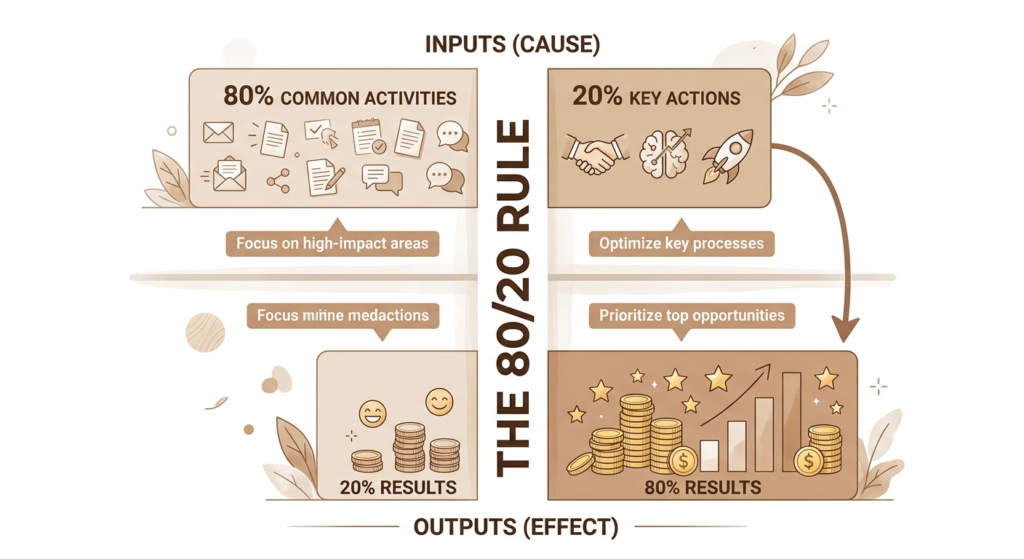
The 80/20 Rule, also known as the Pareto Principle, suggests that roughly 80% of outcomes come from around 20% of causes. The principle takes its name from Italian economist Vilfredo Pareto, who observed in the late nineteenth century that approximately 80% of Italy’s land was owned by about 20% of its population. Over time, researchers and business leaders noticed similar patterns appearing across many different areas of life and work.
Today, the Pareto Principle is widely used as a decision-making framework rather than a rigid rule. The exact percentages may vary, but the underlying message remains the same: a relatively small number of inputs usually produce the majority of results.
In business, this principle appears in surprisingly common ways. Many companies discover that a small group of customers accounts for most of their sales. A handful of products often generate the largest share of profits. Certain marketing campaigns consistently outperform others, while a few key employees drive significant improvements across the organization.
This doesn’t mean the remaining work has no value. Every business still requires planning, administration, customer support, compliance, and maintenance. The purpose of the 80/20 Rule is simply to help entrepreneurs recognize that not every task contributes equally to business growth.
For example, spending an hour building relationships with high-value clients may create a far greater return than spending the same hour reorganizing your inbox. Likewise, improving a marketing campaign that already brings in qualified leads is often more valuable than experimenting with several new strategies at once.
The principle also applies beyond revenue. It can improve productivity, leadership, customer service, sales, hiring, and even personal time management. By consistently identifying your highest-value activities, you begin making decisions based on impact rather than habit.
One important point is worth remembering: the 80/20 Rule should never be treated as an excuse to ignore responsibilities. Instead, it helps entrepreneurs ask better questions:
- Which activities create the biggest results?
- Which customers contribute the most value?
- Which projects deserve more attention?
- Which tasks can be delegated, automated, or eliminated?
Answering these questions helps you focus your energy where it matters most, allowing your business to grow without unnecessary complexity.
Why Most Entrepreneurs Stay Busy but Don’t Grow
Many entrepreneurs start their businesses because they want more freedom. Ironically, they often end up creating jobs for themselves that are more demanding than traditional employment.
The reason isn’t usually a lack of effort. It’s a lack of focus.
As businesses grow, responsibilities multiply. New customers need support, employees require guidance, suppliers have questions, invoices need attention, and opportunities seem to appear from every direction. Without a clear system for prioritizing work, entrepreneurs naturally begin treating every task as equally important.
One of the biggest productivity traps is endless meetings. Meetings can be useful for collaboration and decision-making, but many become recurring calendar events with no clear agenda or measurable outcome. Hours disappear discussing ideas that could have been resolved with a brief conversation or email.
Another common distraction is constant email checking. Every notification creates the feeling that something urgent needs immediate attention. In reality, most emails can wait. Continuously switching between important work and incoming messages interrupts concentration and makes it difficult to complete meaningful projects.
Multitasking is another habit that appears productive but often reduces efficiency. Research consistently shows that constantly shifting between tasks increases mistakes, lowers concentration, and slows overall performance. Focusing on one important task at a time almost always produces better results.
Then there’s perfectionism. Entrepreneurs often spend days refining presentations, redesigning websites, or making minor adjustments to products that customers may never notice. While quality matters, waiting for perfection frequently delays progress and prevents businesses from moving forward.
Administrative work is another silent productivity killer. Bookkeeping, scheduling, data entry, filing documents, and routine reporting are necessary parts of running a business, but they rarely drive growth directly. Spending too much time on repetitive tasks leaves little room for strategic thinking, sales, innovation, or relationship building.
Finally, many entrepreneurs struggle because they chase every opportunity that comes their way. A new partnership, another product idea, an unfamiliar marketing platform, or an exciting side project can all seem worthwhile. But saying yes to everything often means saying no to the work that truly matters.
Successful entrepreneurs understand that growth comes from concentration, not constant activity. They know that every hour spent on low-impact work is an hour taken away from activities that generate revenue, strengthen customer relationships, or improve the business.
Instead of asking, “How can I get more done?” they ask a more valuable question:
“Which few actions will create the biggest difference?”
That shift in thinking is where the real power of the 80/20 Rule begins.
Where the 80/20 Rule Shows Up in Business
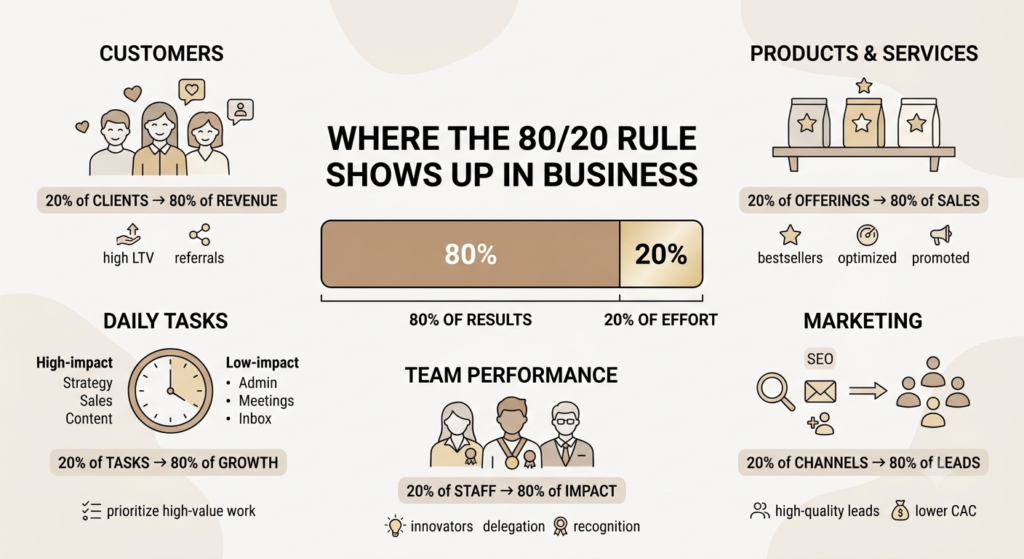
Once you start looking for it, the 80/20 Rule becomes surprisingly easy to spot. Almost every successful business has a few key areas that generate the majority of its results. The challenge is identifying those areas and giving them the attention they deserve.
Instead of spreading your time evenly across every task, customer, or project, focus on the ones that consistently deliver the greatest return.
Customers
For many businesses, a relatively small group of customers contributes the majority of total revenue. These clients not only buy more often but are also more likely to refer others, purchase premium services, and remain loyal over time.
That doesn’t mean other customers aren’t important. Every customer deserves excellent service. However, understanding who your highest-value customers are allows you to build stronger relationships with them through personalized communication, exceptional support, and long-term retention strategies.
Ask yourself:
- Which customers generate the highest lifetime value?
- Who refers the most new business?
- Which clients require the least effort while delivering the best returns?
The answers often reveal where your time should be invested.
Products or Services
Every business has standout offerings.
An online store may sell hundreds of products, yet only a handful consistently account for most sales. A consultant may offer multiple services but discover that one premium package generates the majority of profits. A restaurant may find that a few signature dishes are customer favorites.
Rather than giving equal attention to every product or service, successful entrepreneurs regularly analyze sales data to understand what’s performing best.
Once those top performers are identified, they can:
- Improve them further.
- Promote them more aggressively.
- Bundle them with complementary offers.
- Build marketing campaigns around proven winners.
Trying to push every product equally often spreads resources too thin. Doubling down on your strongest offerings usually delivers far better results.
Marketing
Marketing is another area where the Pareto Principle becomes obvious.
Many businesses invest time and money across multiple channels-social media, email newsletters, paid advertising, search engines, networking events, referral programs, and content marketing.
But when performance is measured carefully, only a few channels consistently bring in qualified leads and paying customers.
Instead of asking, “Where should we market?” ask:
- Which channel produces the highest-quality leads?
- Which platform delivers the lowest customer acquisition cost?
- Where do our best customers come from?
For some businesses, organic search drives most inquiries. Others rely heavily on referrals or email marketing. The key is making decisions based on data rather than assumptions.
When you identify your highest-performing marketing channels, you can invest more confidently while reducing spending on activities that produce little return.
Team Performance
Not every contribution within a business has the same impact.
Some employees naturally become problem solvers, leaders, and innovators. They improve processes, strengthen client relationships, and consistently deliver outstanding work.
Recognizing these high performers allows business owners to:
- Invest in their professional development.
- Delegate important responsibilities.
- Reward strong performance.
- Build future leaders within the organization.
At the same time, managers should avoid relying too heavily on a few individuals. The goal isn’t to overwork your best employees but to understand what makes them successful and help the rest of the team adopt similar habits.
Daily Tasks
Perhaps the most valuable application of the 80/20 Rule is how you spend your day.
Think about everything on your daily to-do list.
Some tasks directly generate revenue, strengthen customer relationships, or move important projects forward.
Others simply maintain the business.
Both categories matter, but they shouldn’t receive equal attention.
High-impact activities often include:
- Meeting potential clients.
- Closing sales.
- Creating valuable content.
- Improving products or services.
- Building strategic partnerships.
- Coaching team members.
- Planning future growth.
Low-value tasks often involve repetitive administration, unnecessary meetings, excessive inbox management, or work that could be delegated.
Successful entrepreneurs make sure their best hours each day are spent on their highest-impact work rather than their easiest tasks.
How Top Entrepreneurs Apply the 80/20 Rule Every Day
Understanding the Pareto Principle is one thing. Applying it consistently is what separates growing businesses from stagnant ones.
Highly successful entrepreneurs build habits that naturally direct their attention toward activities that matter most.
Prioritize Revenue-Generating Work
Before opening emails or checking social media, many business leaders focus on work that directly contributes to business growth.
That might include:
- Following up with potential clients.
- Preparing proposals.
- Developing new products.
- Creating marketing campaigns.
- Strengthening customer relationships.
Completing these tasks early ensures that the most valuable work gets done before distractions take over.
Delegate Repetitive Tasks
Many entrepreneurs believe they need to do everything themselves.
In reality, doing everything often becomes the biggest obstacle to growth.
Routine administrative work, appointment scheduling, bookkeeping, customer support, and data entry can often be delegated to employees or virtual assistants.
Delegation isn’t about giving away responsibility-it’s about creating more time for strategic thinking and leadership.
Every hour spent on work someone else could handle is an hour taken away from work only you can do.
Automate Routine Processes
Technology makes it easier than ever to eliminate repetitive work.
Businesses now automate tasks such as:
- Appointment reminders.
- Invoice generation.
- Email follow-ups.
- Customer onboarding.
- Social media scheduling.
- Lead nurturing.
Automation doesn’t replace human relationships-it removes repetitive manual work so entrepreneurs can focus on creativity, decision-making, and customer experience.
Learn to Say No
One of the most valuable business skills isn’t saying yes.
It’s saying no.
New ideas appear every day.
Someone wants to collaborate.
A customer requests a custom project.
Another networking event pops up.
A new social media platform becomes popular.
While some opportunities are worth pursuing, many simply distract from existing priorities.
Successful entrepreneurs evaluate every opportunity by asking:
“Will this move my business closer to its goals?”
If the answer is no, they politely decline and stay focused.
Review Priorities Every Week
Businesses evolve constantly.
What mattered six months ago may not be the biggest priority today.
That’s why many entrepreneurs schedule a weekly review to assess:
- What’s producing results?
- What’s consuming unnecessary time?
- Which projects deserve more attention?
- Which activities should be paused or eliminated?
This simple habit prevents businesses from operating on autopilot.
Focus on One High-Impact Goal Each Day
Long to-do lists often create the illusion of productivity.
Instead of trying to complete twenty small tasks, identify one activity that would make the biggest difference if completed today.
It could be:
- Closing an important deal.
- Publishing a valuable article.
- Launching a marketing campaign.
- Meeting a potential partner.
- Improving a core product.
Everything else becomes secondary.
Progress compounds when major priorities receive consistent attention.
Measure Results-Not Hours Worked
Entrepreneurs often wear long workdays like a badge of honor.
But working twelve hours doesn’t automatically mean you’ve accomplished more than someone who worked six.
The better question is:
“What results did today’s work create?”
Track meaningful outcomes such as:
- Revenue generated.
- Leads acquired.
- Customers retained.
- Projects completed.
- Time saved through automation.
Focusing on outcomes rather than hours helps you make smarter decisions about where your time is best spent.
A Simple 5-Step 80/20 Audit for Your Business
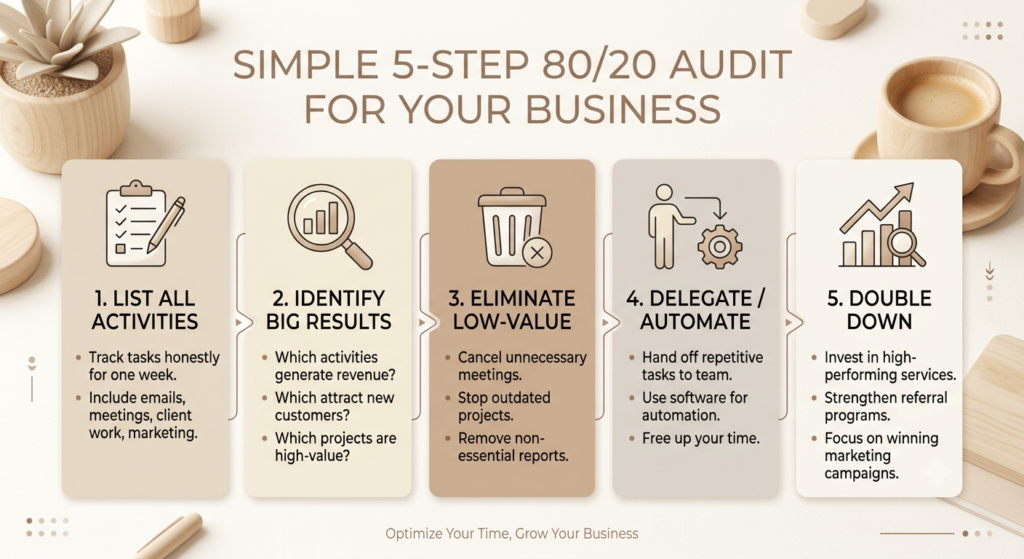
If you’ve never applied the Pareto Principle before, don’t worry. You don’t need complex software or expensive consultants to get started.
This simple exercise can reveal where your biggest opportunities lie.
Step 1: List Everything You Do in a Typical Week
Spend a week tracking your activities honestly.
Include everything-from answering emails and attending meetings to creating proposals, speaking with clients, reviewing finances, and planning marketing campaigns.
Seeing your time on paper often reveals surprising patterns.
Step 2: Identify What Produces the Biggest Results
Now ask yourself:
- Which activities generate revenue?
- Which tasks attract new customers?
- Which projects strengthen the business?
- Which responsibilities only maintain operations?
Circle the activities that consistently produce measurable outcomes.
These are likely part of your most valuable 20%.
Step 3: Eliminate Low-Value Work
Not every task deserves a place on your calendar.
Some meetings can be cancelled.
Some reports don’t need to be created.
Some projects no longer support your goals.
Removing unnecessary work creates space for activities that actually move the business forward.
Remember, productivity isn’t about doing more-it’s about doing what matters most.
Step 4: Delegate or Automate Repetitive Tasks
Review everything that remains.
Ask:
- Can someone else do this?
- Can software handle this?
- Does this task need to happen this often?
Delegating and automating repetitive work allows you to spend more time leading your business instead of managing routine operations.
Step 5: Double Down on Your Best Activities
Finally, increase your investment in what already works.
If referrals consistently bring your best customers, strengthen your referral program.
If one service generates most of your profits, improve and promote it.
If certain marketing campaigns outperform everything else, allocate more resources to them.
Growth doesn’t always require doing something new.
Sometimes it comes from doing more of what already delivers exceptional results.
Common Mistakes When Using the 80/20 Rule
The 80/20 Rule is a powerful way to work smarter, but it’s easy to misunderstand. Many entrepreneurs become so focused on finding the “important 20%” that they end up making decisions that hurt their business in the long run.
Here are some of the most common mistakes to avoid.
Thinking Every Low-Value Task Can Be Ignored
Not every task directly generates revenue, but that doesn’t make it unimportant.
Bookkeeping, customer support, payroll, compliance, and maintenance work are all essential to keeping a business running smoothly. Ignoring these responsibilities can lead to operational problems that outweigh any time you save.
The goal isn’t to eliminate necessary work-it’s to spend less time on it by creating better systems or delegating where possible.
Eliminating Important Maintenance Work
Entrepreneurs often become excited about growth and overlook the importance of maintaining what they’ve already built.
For example, spending all your time acquiring new customers while neglecting existing ones can reduce customer loyalty. Likewise, constantly launching new products without improving your current offerings may weaken your overall brand.
Growth and maintenance should work together. The 80/20 Rule helps you prioritize, not neglect.
Misidentifying the Valuable 20%
Many business owners rely on assumptions instead of data.
You might believe social media is your biggest source of leads because it gets the most likes and comments. However, your website, referrals, or email campaigns may actually generate far more paying customers.
That’s why it’s important to review sales reports, customer feedback, website analytics, and marketing performance regularly. Decisions based on facts are far more effective than decisions based on guesswork.
Measuring Effort Instead of Results
Working harder doesn’t always mean achieving more.
It’s easy to feel productive after spending an entire day responding to emails or attending meetings. But if those activities don’t move your business forward, they aren’t creating meaningful value.
Instead of asking, “How busy was I today?” ask, “What did I accomplish today that had a real impact on my business?”
Focusing on outcomes rather than hours helps you make better use of your time.
Never Reviewing Priorities
Businesses are constantly evolving. A strategy that worked a year ago may not be the best use of your time today.
Customer needs change. Markets shift. New opportunities emerge.
That’s why successful entrepreneurs revisit their priorities on a regular basis. Reviewing your goals every month or quarter ensures you’re always focusing on the activities that create the greatest impact.
Tools That Make the 80/20 Rule Easier to Apply
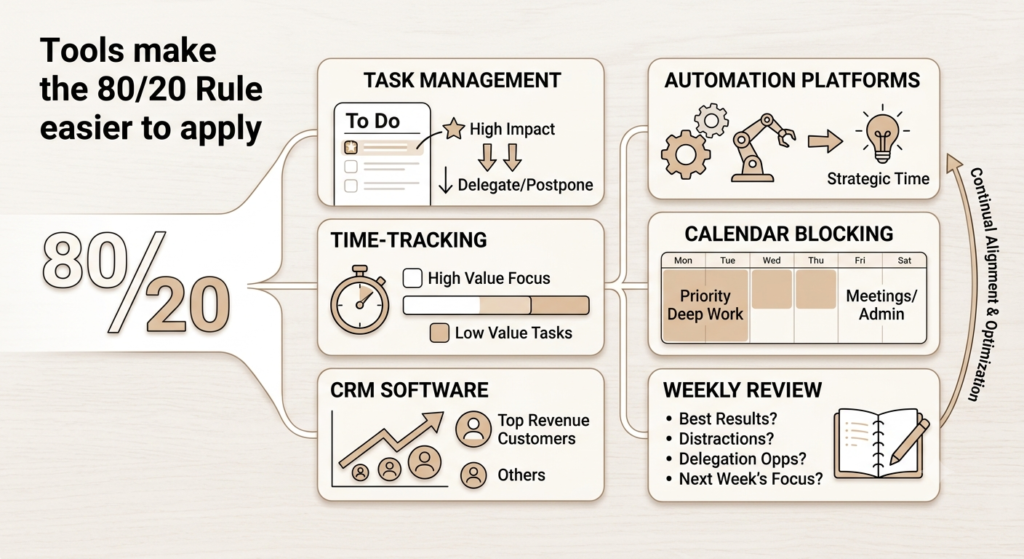
You don’t need expensive software to apply the 80/20 Rule, but the right tools can make it much easier to identify where your time is going and which activities deliver the best results.
Task Management Apps
Task management platforms help you organize projects, prioritize important work, and avoid getting overwhelmed by long to-do lists.
By categorizing tasks based on urgency and impact, you can clearly see which activities deserve your immediate attention and which can be postponed or delegated.
Time-Tracking Tools
Most entrepreneurs are surprised when they discover how much time they spend on low-value work.
Time-tracking tools provide a clear picture of your daily habits, helping you identify tasks that consume hours without producing meaningful results.
Once you know where your time is going, making improvements becomes much easier.
CRM Software
Customer Relationship Management (CRM) systems help businesses understand which customers generate the most revenue, how leads move through the sales process, and where new business opportunities come from.
Instead of treating every customer the same, a CRM allows you to focus your attention on the relationships that create the greatest long-term value.
Automation Platforms
Automation tools reduce repetitive manual work by handling routine tasks such as follow-up emails, appointment reminders, invoice generation, lead nurturing, and customer onboarding.
The time saved can be redirected toward activities that require creativity, leadership, and strategic thinking.
Calendar Blocking
One of the simplest productivity techniques is calendar blocking.
Instead of reacting to tasks throughout the day, schedule dedicated time for your highest-priority work.
For example, reserve your first two hours each morning for business development, sales, or strategic planning before opening your inbox or attending meetings.
Protecting this time helps ensure your most important work always gets done.
Weekly Review Systems
A weekly review gives you an opportunity to reflect on what’s working and what isn’t.
During your review, ask yourself:
- Which activities produced the best results this week?
- What distracted me from my priorities?
- Which tasks could be delegated or automated?
- What should I focus on next week?
This simple habit keeps your business aligned with your long-term goals instead of allowing busy work to take over.
Real-Life Examples of the 80/20 Rule in Action
The Pareto Principle isn’t just a theory. Entrepreneurs across different industries apply it every day to improve efficiency and grow their businesses.
A Consultant Focuses on High-Value Clients
A business consultant offers services to companies of all sizes. After reviewing annual revenue, she realizes that around 20% of her clients contribute nearly 80% of her income.
Rather than trying to serve everyone equally, she decides to focus on attracting more clients who fit that profile. She introduces premium consulting packages, strengthens relationships with existing high-value clients, and reduces time spent on low-budget projects.
As a result, her revenue increases without working longer hours.
An eCommerce Business Prioritizes Best-Selling Products
An online retailer sells hundreds of products, but sales reports reveal that only a small group of items consistently drives most of the company’s profits.
Instead of expanding the catalog further, the business invests in improving product pages, increasing inventory for top sellers, and running targeted advertising campaigns around those products.
The result is higher sales, better inventory management, and improved profitability.
A Content Creator Doubles Down on What Works
A creator publishes blogs, podcasts, videos, newsletters, and social media posts every week.
After reviewing performance data, they discover that long-form educational videos generate the majority of subscribers, website traffic, and sponsorship opportunities.
Instead of producing content across every platform equally, they prioritize high-quality video content while reducing time spent on lower-performing formats.
Their audience grows faster because their efforts are concentrated where they have the biggest impact.
A Startup Founder Prioritizes Sales
During the early stages of launching a company, a founder spends countless hours perfecting branding, redesigning presentations, and organizing internal documents.
Eventually, they realize none of those tasks matter if customers aren’t buying.
They shift their attention toward sales conversations, customer feedback, and product improvement.
Within months, the business gains paying customers and builds the momentum needed for long-term growth.
The lesson is simple: growth comes from focusing on the work that directly creates value.
Key Takeaways
The 80/20 Rule reminds us that not every task deserves equal attention.
In business, a small number of actions often produce the majority of results. Identifying those high-impact activities allows entrepreneurs to make better decisions, improve productivity, and grow without constantly increasing their workload.
Keep these principles in mind:
- Focus on the vital few instead of the trivial many.
- Prioritize activities that generate revenue, strengthen customer relationships, and support long-term growth.
- Delegate or automate repetitive work whenever possible.
- Protect your time-it is one of your most valuable business assets.
- Review your priorities regularly because your business will continue to evolve.
Small improvements in where you invest your time can produce significant results over months and years.
Conclusion
Success in business isn’t about filling every hour of your day with work. It’s about making sure the work you do actually moves your business forward.
The 80/20 Rule offers a practical framework for cutting through the noise and focusing on what truly matters. By identifying the customers, products, marketing strategies, and daily activities that create the greatest impact, you can make smarter decisions, reduce unnecessary stress, and achieve more without working around the clock.
Start with a simple audit of your weekly schedule. Identify the tasks that consistently produce meaningful results, eliminate or delegate those that don’t, and commit to spending more time on work that drives growth.
Over time, these small shifts in focus can lead to stronger performance, better work-life balance, and a business that’s built on intentional action rather than constant busyness.
Frequently Asked Questions
What is the 80/20 Rule in entrepreneurship?
The 80/20 Rule, also known as the Pareto Principle, suggests that a small percentage of activities often generates the majority of business results. Entrepreneurs use this concept to focus on high-impact tasks that drive growth, revenue, and productivity.
How can entrepreneurs use the Pareto Principle to improve productivity?
Entrepreneurs can improve productivity by identifying which tasks create the greatest results, prioritizing those activities, delegating repetitive work, automating routine processes, and regularly reviewing their priorities to eliminate low-value tasks.
Is the 80/20 Rule scientifically proven?
The Pareto Principle is not a scientific law or exact mathematical formula. Instead, it is an observation that similar patterns frequently appear in business, economics, and everyday life. It serves as a practical decision-making framework rather than a guaranteed ratio.
How do I identify the 20% of tasks that generate 80% of results?
Track your activities for a week and measure their outcomes. Look for tasks that consistently generate revenue, attract customers, improve products, or strengthen relationships. Those are typically your highest-value activities.
Can the 80/20 Rule help small business owners grow faster?
Yes. Small business owners often have limited time and resources. By concentrating on the activities that deliver the greatest return, they can improve efficiency, reduce wasted effort, and focus on sustainable business growth.
What are the biggest mistakes people make when applying the 80/20 Rule?
Common mistakes include ignoring essential maintenance tasks, relying on assumptions instead of data, trying to eliminate every low-value task, measuring effort instead of outcomes, and failing to review priorities as the business evolves.