

Right now, more people want to start a business than at almost any point in recent memory. One in three U.S. adults say they plan to start a business or side hustle within the next year, a jump of nearly 94 percent compared to the year before. People aren’t just dreaming about it either – over half of them say they’ll launch even if the economy isn’t cooperating.
And yet, the failure numbers haven’t moved much. Roughly one in five new businesses still doesn’t make it past year one. Only about a quarter survive past the fifteen-year mark. So if more people than ever are starting businesses, and the failure rate is staying roughly flat, what’s actually separating the entrepreneurs who make it from the ones who don’t?
It’s not funding. It’s not a better idea. In most cases, it’s not even talent.
It’s habits.
The entrepreneurs who build something that lasts aren’t running on bursts of inspiration. They’ve built a set of daily and weekly behaviors that keep working even on the days they don’t feel like it. That’s the part nobody puts on a vision board – the boring, repeatable stuff that compounds quietly in the background until one day you look up and your business looks completely different.
This article walks through ten of those habits. Not hustle-culture clichés. Real, practical patterns that show up again and again in entrepreneurs who build durable businesses – the kind that survive year five, year ten, and beyond.
Why Business Habits Matter More Than Talent
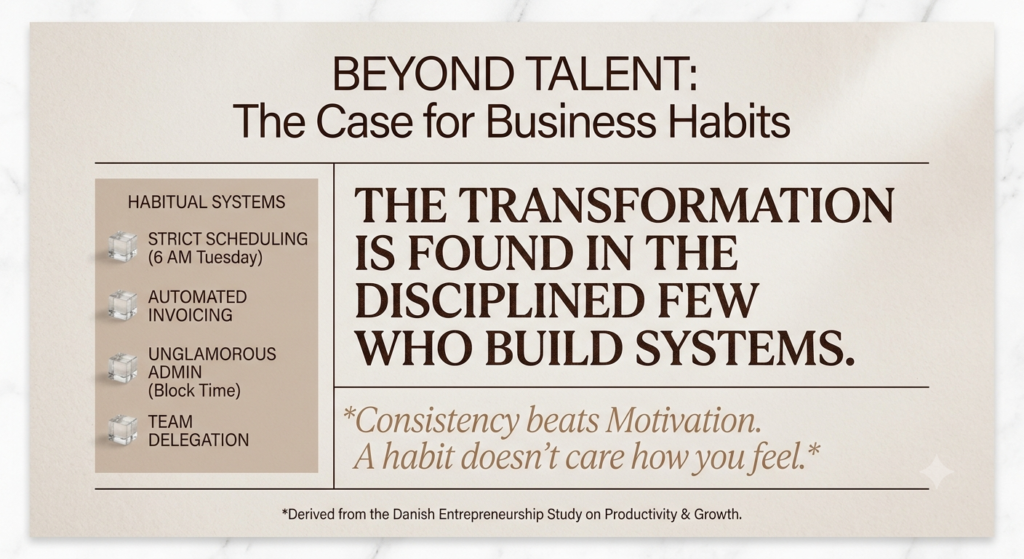
Here’s something worth sitting with: researchers who studied entrepreneurship using a detailed dataset out of Denmark found that only a small minority of entrepreneurs are what they called “transformative” – the ones who generate disproportionate gains in productivity and growth. These weren’t necessarily the most naturally gifted founders. They were the ones who built the right systems and brought in the right people around them.
That distinction matters because it tells you success isn’t randomly distributed among the talented. It’s concentrated among the disciplined.
Talent gets you a good first year. It might even get you a great launch. But talent doesn’t show up for you at 6 a.m. on a Tuesday when you’re tired, behind on invoices, and the thing you actually need to do is unglamorous admin work. Habits do.
This is also why “consistency beats motivation” isn’t just a motivational poster line – it’s closer to an operating principle. Motivation is a mood. It comes and goes based on sleep, stress, and how your last client call went. A habit doesn’t care how you feel. You do it because it’s Tuesday, not because you’re inspired.
The entrepreneurs who last build systems instead of relying on willpower. They don’t wake up every day trying to figure out what to do – they’ve already built the structure that tells them.
1. They Start Every Day With Clear Priorities
Most people don’t start their day. Their day starts them. They open their inbox, see twelve things demanding attention, and spend the next four hours reacting instead of working.
Successful entrepreneurs flip that order. Before they open anything, they already know what actually matters that day.
Planning Before Reacting
This sounds obvious, but very few people actually do it. The habit is simple: before you check email, before you check Slack, before you look at your phone, you decide what the day is actually for. Even five minutes of this – written down, not just thought about – changes how the rest of the day unfolds.
The “Top 3 Tasks” Rule
A long to-do list feels productive but usually isn’t. It’s a comfort blanket. The entrepreneurs who consistently move their business forward tend to work from a much shorter list – often just three tasks that, if completed, would make the day a genuine win regardless of what else happens.
The logic here is straightforward. If you have twenty things on a list, you’ll likely do the easiest five and call it a day. If you have three, and they’re the right three, you can’t hide from them.
Avoiding Busy Work
This is where the real damage gets done. Research on workplace productivity found that more than half of people’s time is spent on busywork – chasing the status of tasks, searching for information, communicating about work instead of doing it. Less than half goes to the strategic, skilled work people were actually hired or built their business to do.
If you’re an entrepreneur, that ratio is even riskier, because you don’t have a manager checking whether your time went somewhere useful. Successful founders treat “is this task actually moving the business forward, or does it just feel productive” as a daily filter, not an occasional gut check.
2. They Make Decisions Using Data, Not Emotions
Gut instinct has its place, especially early on when you don’t have enough data to lean on yet. But the entrepreneurs who scale past the early stage tend to shift away from “I feel like this is working” toward “here’s what the numbers actually show.”
KPIs That Actually Matter
Not all metrics deserve your attention. There’s a meaningful difference between vanity metrics – the ones that feel good but don’t predict anything – and what some business analysts now call high-velocity metrics, the ones that actually forecast where your bank balance will be months from now.
Revenue is a lagging indicator. By the time it moves, the decision that caused it already happened weeks ago. Smart entrepreneurs track the inputs that move revenue before revenue itself moves – things like customer acquisition cost relative to margin, or how quickly a new customer actually starts paying for themselves.
Analytics
This doesn’t mean drowning in dashboards. It means picking a small number of numbers you actually look at on a regular rhythm, and being honest about what they’re telling you, even when the story isn’t flattering.
Customer Feedback
Numbers tell you what happened. Customers tell you why. The entrepreneurs who build loyal customer bases tend to treat feedback – good and bad – as research, not as a performance review of their ego.
Financial Reports
A lot of founders avoid their own financial statements the way some people avoid the scale. But entrepreneurs who stick around long-term make a habit of actually reading their numbers, not just forwarding them to an accountant and hoping for good news. You don’t need to be a CFO. You just need to stop being afraid of the spreadsheet.
3. They Build Systems Instead of Depending on Motivation
This is probably the single biggest difference between a business that depends entirely on its founder and one that can actually grow.
SOPs (Standard Operating Procedures)
If a task gets done the same way more than twice, it deserves a written process. Not because you don’t trust yourself to remember it – because the moment you bring on a contractor, a virtual assistant, or an employee, that SOP is the difference between training them in twenty minutes or two weeks.
I’ve seen this play out directly in property management and short-term rental operations, where the gap between a chaotic business and a calm one almost always comes down to whether check-in, cleaning, and guest communication processes are documented or living entirely in someone’s head.
Automation
Plenty of small, repetitive tasks don’t need a human at all – sending a follow-up email, generating an invoice, flagging a low inventory level. Automating these isn’t about replacing judgment. It’s about saving judgment for the decisions that actually need it.
Checklists
A checklist isn’t a sign you don’t know what you’re doing. It’s a sign you’ve decided not to rely on memory for things that matter. Pilots use checklists before every single flight, regardless of how many hours they’ve logged. There’s no reason a business handling client deliverables or guest stays should hold itself to a lower standard.
Repeatable Workflows
The end goal of all of this is a business that doesn’t fall apart the one week you’re sick or on a flight with no Wi-Fi. If your business can only run when you’re personally present and personally exhausted, you haven’t built a business – you’ve built a very demanding job.
4. They Protect Their Time Ruthlessly
Time is the one resource you can never buy back, and successful entrepreneurs treat it that way. This habit gets talked about constantly in generic terms – “manage your time better” – without much explanation of what that actually looks like day to day.
Saying No Without Guilt
Every yes to a request, a meeting, or a “quick call” is a no to something else, usually something more important that you’ve already planned. Entrepreneurs who protect their growth learn to say no early and clearly, instead of agreeing reluctantly and resenting it later.
Time Blocking
This means assigning specific blocks of your calendar to specific types of work – deep work, client calls, admin – instead of letting the day fill itself organically. The point isn’t rigid perfection. It’s making sure your most important work has a guaranteed slot before anything else can claim it.
Delegation
This is where a lot of founders get stuck, often for emotional reasons more than logical ones. Letting go of a task you’re good at, to someone who might do it slightly differently, feels uncomfortable. But the math is simple: if a task costs you two hours and someone else can do it competently for a fraction of what your time is worth, holding onto it isn’t loyalty to quality – it’s a tax on your growth.
Avoiding Unnecessary Meetings
Most competitor content stops at “manage your calendar.” What actually moves the needle is defending it. That means questioning every recurring meeting on your calendar and asking whether it still earns its slot, and it means being comfortable declining meetings that don’t have a clear agenda or outcome attached. Workflow tools alone have been shown to save the average worker the equivalent of more than twelve weeks of productive time a year – and that’s before you even touch meeting discipline.
5. They Never Stop Learning
The entrepreneurs who plateau are usually the ones who decided, somewhere along the way, that they’d already learned enough.
Books, Podcasts, and Courses
The format matters less than the intent. Passive consumption – listening to a podcast while doing dishes – is fine for inspiration, but it rarely changes behavior on its own. The entrepreneurs who actually grow from what they consume tend to follow up with one small action based on what they learned, instead of just moving on to the next piece of content.
Mentors
A good mentor shortens the distance between making a mistake and learning from it. Instead of discovering the hard way that a certain pricing model doesn’t work, you hear it from someone who already paid that tuition.
Industry Research
Markets move. What worked two years ago in your industry might already be outdated. Staying current isn’t optional anymore – it’s part of the job description.
Learning From Competitors and Customers
This is a habit that gets skipped surprisingly often. Watching what competitors are doing well – and badly – gives you a free education most people ignore. And customers, especially the ones who complain, are often handing you a roadmap for what to fix next, free of charge.
There’s also a newer layer to this in 2026: a growing share of aspiring entrepreneurs are now using AI tools specifically to speed up market research and idea validation before they even launch. The tool has changed. The underlying habit – staying curious and gathering outside information before deciding – hasn’t.
6. They Solve Problems Before They Become Crises
This is the habit most competitor articles skip entirely, and it’s one of the most valuable ones on this list.
Thinking Ahead
Reactive entrepreneurs handle problems as they show up. Proactive ones spend time regularly asking, “what could go wrong here, and what would we do if it did?” That single question, asked consistently, prevents a huge percentage of full-blown crises.
Risk Management
This doesn’t mean avoiding risk – entrepreneurship is inherently risky. It means knowing which risks you’re knowingly taking and which ones you’re accidentally exposed to because you never checked. A business with one major client, one supplier, or one key employee is carrying concentration risk whether or not anyone’s looked at it directly.
Scenario Planning
You don’t need elaborate models for this. Even a simple exercise – what happens if our biggest client leaves, what happens if costs rise 20 percent – forces you to build contingencies before you need them, not while you’re scrambling.
Decision Frameworks
When a crisis does hit, the entrepreneurs who handle it well usually aren’t improvising. They’ve thought in advance about how they make hard calls under pressure – what information they need, who they consult, how fast they’re willing to move. Having that framework ready means you’re not building the plane while flying it.
7. They Invest in Relationships, Not Just Networking
There’s a meaningful difference between collecting contacts and building relationships, and successful entrepreneurs tend to know exactly where that line is.
Networking vs. Building Trust
Networking is showing up at an event and exchanging cards. Trust is built over repeated, honest interactions over time – showing up for someone before you need anything from them.
Partnerships
The strongest business partnerships rarely start as formal negotiations. They usually start as smaller collaborations that prove the relationship works before either side commits to something bigger.
Long-Term Collaborations
A one-time referral is nice. A long-term collaborator who consistently sends you business, vouches for your work, or partners with you year after year is a completely different category of asset – and it’s built through consistency, not charisma.
Personal Brand
Your personal brand, at its core, is just your reputation operating at scale. Entrepreneurs who invest in being known for reliability, honesty, and follow-through end up with opportunities that never had to be chased, because people brought the opportunities to them instead.
8. They Review Business Performance Every Week
This is one of the most practical, and most underused, habits on this list.
The Weekly Business Review Habit
This concept was popularized by Amazon, where teams across the company hold structured weekly meetings to review performance metrics, spot trends, and flag problems before they grow. The format has since spread well beyond Amazon, because the logic behind it works for businesses of any size: a problem caught in week one is a tweak. The same problem caught in month three is a crisis.
You don’t need Amazon’s scale to copy the habit. Even a solo founder can block thirty minutes every week to look honestly at what’s working and what isn’t.
Revenue and Sales Pipeline
A quick weekly look at what’s coming in, and what’s likely to come in over the next few weeks, keeps you from being blindsided by a slow month you could have seen coming.
Customer Satisfaction and Marketing Metrics
Are people happy? Is your marketing actually converting, or just generating activity? These questions are easy to lose track of in the day-to-day grind, which is exactly why they need a dedicated weekly slot instead of living in the back of your mind.
Team Progress
For entrepreneurs with even a small team, a weekly check-in on progress – without slipping into micromanagement – keeps everyone aligned without anyone feeling watched. Entrepreneurs who build a consistent habit of reviewing their goals on a regular cadence tend to hit those goals significantly more often than those who only check in occasionally. The review itself becomes the accountability system, so you don’t need to manufacture pressure artificially.
9. They Prioritize Their Physical and Mental Energy
For a long time, “hustle” meant sacrificing sleep and health for output. That mindset is fading, and for good reason – it never actually worked as well as it looked like it did.
Sleep
Sleep isn’t downtime from your business. It’s an input into it. Cutting sleep to gain an extra hour of work almost always produces worse decisions, slower thinking, and more mistakes than the hour was worth.
Energy Management
Time management asks “how do I fit more in.” Energy management asks a better question: “when am I actually sharp, and what should I be doing during that window?” Entrepreneurs who manage energy well protect their highest-focus hours for their hardest thinking, and save lower-energy hours for routine tasks.
Deep Work
This matters more than most people realize. On average, professionals get fewer than three real deep work sessions a week, while reporting they’d need more than four to actually feel productive. That gap is where a lot of meaningful business progress quietly disappears – eaten by notifications, meetings, and constant context-switching.
Stress Recovery and Work-Life Sustainability
Running a business is genuinely stressful – a significant share of entrepreneurs report struggling with high stress levels, and that’s not a personal failing, it’s an occupational reality. The habit that separates burned-out founders from sustainable ones isn’t avoiding stress entirely. It’s building in deliberate recovery – actual rest, not just lower-intensity work – so the stress doesn’t compound unchecked.
10. They Take Action Before They Feel Ready
The last habit might be the most important one, because it’s the thing that activates all the others.
Overcoming Perfectionism
Perfectionism feels like high standards. In practice, it’s often fear wearing a respectable disguise. Waiting for a plan, a product, or a pitch to be perfect before shipping it usually just means waiting until someone else ships first.
Calculated Risk-Taking
This isn’t about recklessness. It’s about understanding that some decisions are reversible and some aren’t, and being willing to move quickly on the reversible ones instead of treating every choice like it’s permanent.
Learning Through Execution
You learn more from one imperfect launch than from a year of planning a perfect one. Real customers, real feedback, and real numbers teach you things no amount of internal debate ever will.
Continuous Improvement
Action isn’t a one-time leap – it’s a loop. Ship something, see what happens, adjust, ship again. Entrepreneurs who build this rhythm into their week treat “good enough to learn from” as the standard, not “perfect enough to be safe.”
Common Habits That Hold Entrepreneurs Back
Just as important as what successful entrepreneurs do is what they’ve deliberately stopped doing.
Constant multitasking. Splitting attention across five things at once feels productive and almost always produces worse results on all five than focused, sequential effort would.
Chasing shiny objects. Jumping to the next exciting idea before the current one has had a fair chance to work is one of the quietest ways founders sabotage their own momentum.
Lack of planning. Reacting to each day as it comes, with no sense of weekly or monthly direction, keeps a business stuck in survival mode indefinitely.
Avoiding delegation. Holding onto every task “because no one else will do it right” guarantees the business can never grow beyond what one person can personally carry.
Waiting for motivation. Treating motivation as a prerequisite for action, instead of building systems that work regardless of mood, is one of the most common reasons good ideas never become real businesses.
Micromanaging. Hovering over every detail a team member handles doesn’t produce better outcomes – it produces a team that stops thinking for itself and waits to be told what to do.
How to Build These Business Habits Without Feeling Overwhelmed
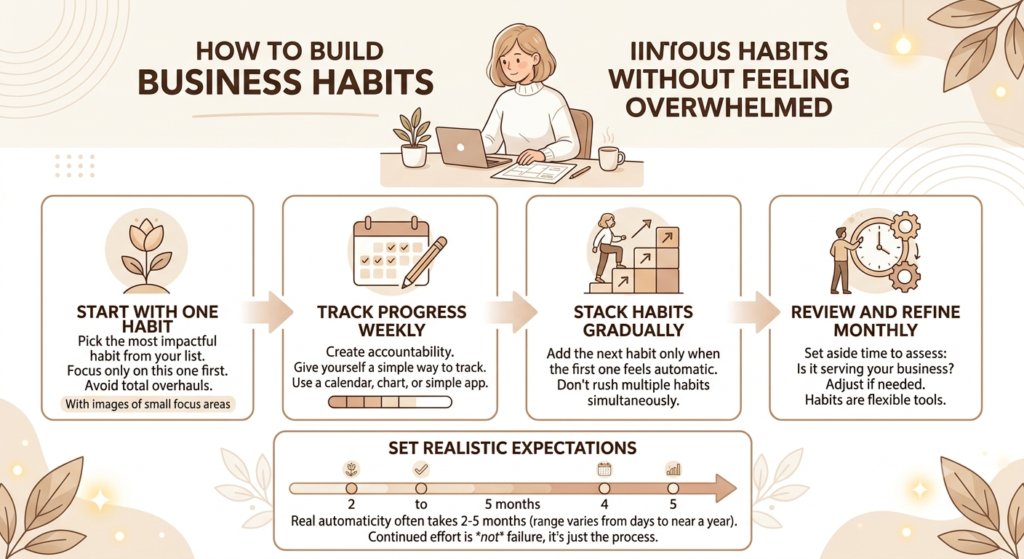
Reading a list of ten habits and trying to adopt all of them on Monday morning is a recipe for giving up by Wednesday. Here’s a more realistic approach.
Start With One Habit
Pick the single habit from this list that would make the biggest difference in your business right now, and focus there first. Trying to overhaul everything at once almost always backfires.
Track Progress Weekly
Whatever habit you’re building, give yourself a simple way to check whether you actually did it. This doesn’t need to be complicated – a checkmark on a calendar is enough to create accountability.
Stack Habits Gradually
Once one habit feels automatic – something you do without negotiating with yourself first – add the next one. Trying to build all ten simultaneously usually means building none of them well.
Review and Refine Monthly
Set aside time once a month to ask honestly: is this habit actually working, or does it need adjusting? Habits aren’t supposed to be rigid. They’re supposed to serve the business, and if one isn’t, it’s fine to change it.
It’s also worth setting realistic expectations here. Research on habit formation suggests it typically takes somewhere between two and five months for a new habit to feel automatic, though the range can stretch from a matter of days to nearly a year depending on the habit and the person. If a new habit still feels effortful after two weeks, that’s not failure – that’s just the normal timeline doing its job.
Final Thoughts
None of the habits on this list are flashy. There’s no secret hack hiding in here, no shortcut that skips the work. What they have in common is that each one, on its own, seems small – a daily priority list, a weekly review, a checklist, an honest look at the numbers. But stacked together and repeated for months, they become the actual difference between a business that survives and one that doesn’t.
Success in entrepreneurship isn’t built in a single decision. It’s built in the hundreds of small, unremarkable ones that happen every single week, especially the ones nobody else ever sees.
If you take one thing from this article, let it be this: pick one habit from this list, the one your business needs most right now, and start it this week. Not all ten. Just one. The rest can follow once that one becomes automatic.
Frequently Asked Questions
What habits do successful entrepreneurs have?
Successful entrepreneurs tend to share a small set of consistent behaviors: clear daily priorities, data-driven decision-making, documented systems instead of relying on memory, protected time, ongoing learning, proactive risk management, genuine relationship-building, weekly performance reviews, deliberate energy management, and a willingness to act before everything feels perfectly ready.
Which daily habit has the biggest impact on business success?
Starting each day with clear priorities tends to have the most immediate impact, because it determines whether your time goes toward what actually matters or simply toward whatever shows up first in your inbox.
How long does it take to build productive business habits?
Most research on habit formation points to somewhere between two and five months for a new habit to start feeling automatic, though this varies depending on the complexity of the habit and the person building it.
Can anyone develop entrepreneurial habits?
Yes. These habits aren’t tied to a specific personality type or natural talent. They’re learned behaviors, which means they can be built deliberately by anyone willing to practice them consistently.
What habits should new entrepreneurs avoid?
New entrepreneurs should be cautious of constant multitasking, chasing every new idea before finishing the current one, skipping planning altogether, avoiding delegation out of a need for control, waiting for motivation instead of building structure, and micromanaging their team.
How do successful entrepreneurs stay productive every day?
They rely on systems rather than willpower – clear daily priorities, protected time blocks, documented processes, and regular performance reviews – so their productivity doesn’t depend on how motivated or energetic they happen to feel on a given day.